
Oct
15
Custom plugin development in Django CMS serves as a roadmap to transform traditional content management systems into customized business platforms.
Django CMS is well known for its modular architecture and Python backbone. This allows developers the flexibility to create content-rich, interactive, and dynamic websites that align with business requirements.
There are chances when relying on default plugins often misses the mark for specialized functionality, such as advanced analytics dashboards, marketing automation, or custom forms. This is where custom plugin development becomes a necessity.
When integrating Python CMS development, developers enjoy the freedom to extend Django CMS functionality. Each plugin is set to address unique operational goals while ensuring seamless integration with the CMS core.
Capsquery, a leading Django CMS development agency, has helped businesses across the globe build custom Django CMS setups. We have proven experience working with startups and big companies in places like Texas, Houston, Cupertino, San Jose, and Dallas. Our team of expert developers builds solutions that scale with your needs, work efficiently, and boost user engagement.
Django CMS is a powerful open-source content management system developed on the Python Django framework. Its modern architecture allows developers to add reusable components known as plugins. Such extensions provide the platform with more functionalities than simple content management features. Each plugin is a small, encapsulated component of functionality that can be added to pages, giving the upper hand with flexibility and reusability.
Default Plugins vs Custom Plugins:
Custom plugins allow Django CMS to grow along with your business. It adapts to new requirements without messing up existing workflows.
Custom plugin development in Django CMS brings great upgrades for your business’s digital presence and is beneficial for both businesses and developers. Here are the top reasons that mark custom plugin development in Django CMS is the ideal choice:

Custom plugins allow businesses to integrate features that go along with the existing workflows. For example, an online store with lots of content might require functionality that offers custom product recommendations, whereas a media agency may require interactive galleries or subscription forms.
Custom plugins ease managing complex content, cutting down repetitive manual tasks and allowing editors to maintain dynamic pages effortlessly.
Companies leverage custom plugins for advanced forms, analytics dashboards, SEO tools, and personalized content blocks, providing efficient user engagement and operational insights.
With Django CMS customization, developers can write code that’s easy to scale up, maintain, and use again. This makes everything run better and reduces development costs in the future.
Custom plugins allow you to develop unique websites and stand out from the competitors with interactive features that may not be possible with default plugins.
To develop custom plugins effectively, understanding Django CMS plugin architecture is a crucial choice. Plugins bring more than visual requirements; they are well-integrated Python modules that integrate with the main CMS system.

Each plugin has three main components: models that set up how data is organized, plugin classes defining behavior, and templates that render content. Keeping these separate makes everything easier to manage and maintain.
Django apps allow you to seamlessly align with CMS plugins without problems. This lets developers build complicated features like user dashboards or forms that connect to APIs. This allows you to maintain a clean and organized code.
CMSPluginBase is the core class that all Django CMS plugins inherit. It sets up how the plugin behaves, configuration, and display logic. This makes an essential choice for custom plugins development.
Templates feature the plugin output on the frontend. Developers can design interfaces that work on different devices and let people interact with them. The plugin’s backend logic stays separate and contained.
Plugin models define how data gets saved and retrieved. Using Django ORM makes sure plugins work with the database efficiently. It also supports migrations and scale when required.
Developing a custom plugin in Django CMS follows a clear yet systematic approach, combining Python backend logic with Django CMS’s modular architecture. Each step ensures your plugin can scale, function in multiple locations, and integrate seamlessly into your CMS.
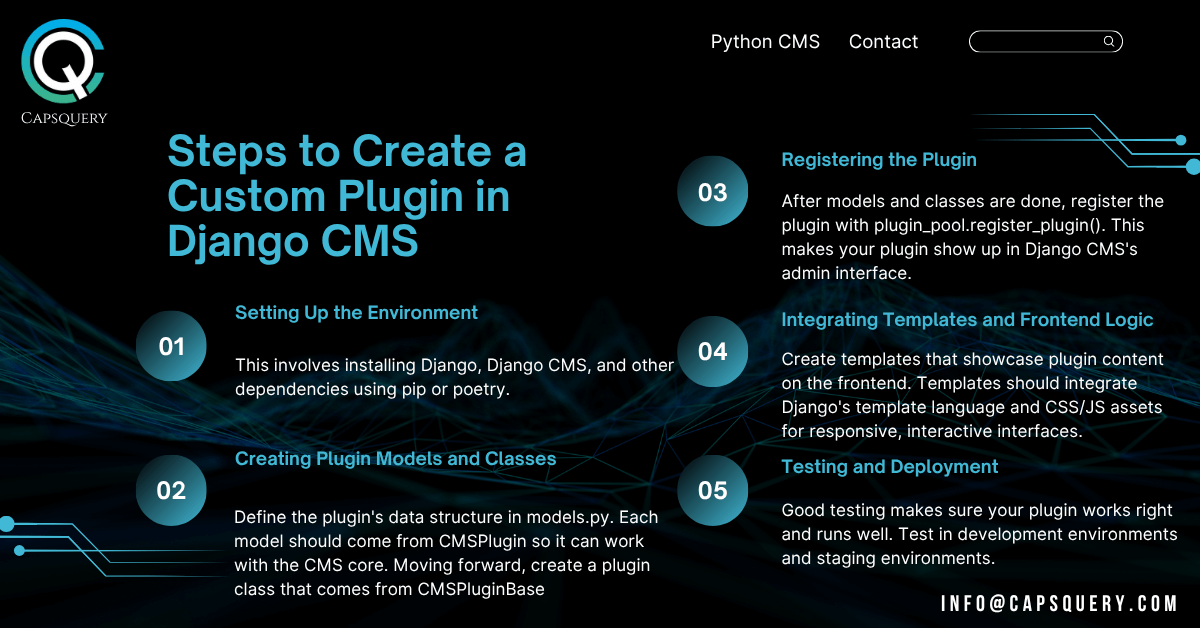
Start by setting up a Django CMS project environment. This involves installing Django, Django CMS, and other dependencies using pip or poetry. Creating a virtual environment keeps dependencies separate, making sure custom plugins won’t mess up various project components.
Configuring settings.py for templates, installed apps, and static files. When your environment is properly ready, development goes smoother and the plugin integration is easier.
Define the plugin’s data structure in models.py. Each model should come from CMSPlugin so it can work with the CMS core. Models store information that the plugin displays, such as text, images, or settings.
Moving forward, create a plugin class that comes from CMSPluginBase defining the model, template, name, and, if applicable, caching settings. This class manages how the plugin behaves and what the admin interface looks like.
After models and classes are done, register the plugin with plugin_pool.register_plugin(). This makes your plugin show up in Django CMS’s admin interface. Editors can then add it to pages. Proper registration ensures your plugin is recognized throughout the CMS, ready to dominate the content management process.
Create templates that showcase plugin content on the frontend. Templates should integrate Django’s template language and CSS/JS assets for responsive, interactive interfaces. Developers must integrate Frontend logic, including AJAX calls or JavaScript features, while keeping backend and template layers apart. Keeping them separate makes code easier to read and helps it grow.
Good testing makes sure your plugin works right and runs well. Test in development environments and staging environments. This covers edge cases, database interactions, and how it renders at the frontend. Once the validation process is facilitated, start deploying the plugin with your CMS project. Keep up with the regular updates and maintenance to align with Django CMS upgrades and stay secure.
Following best practices for Django CMS plugin development ensures that custom Django CMS plugins remain easy to maintain, secure, and fast.
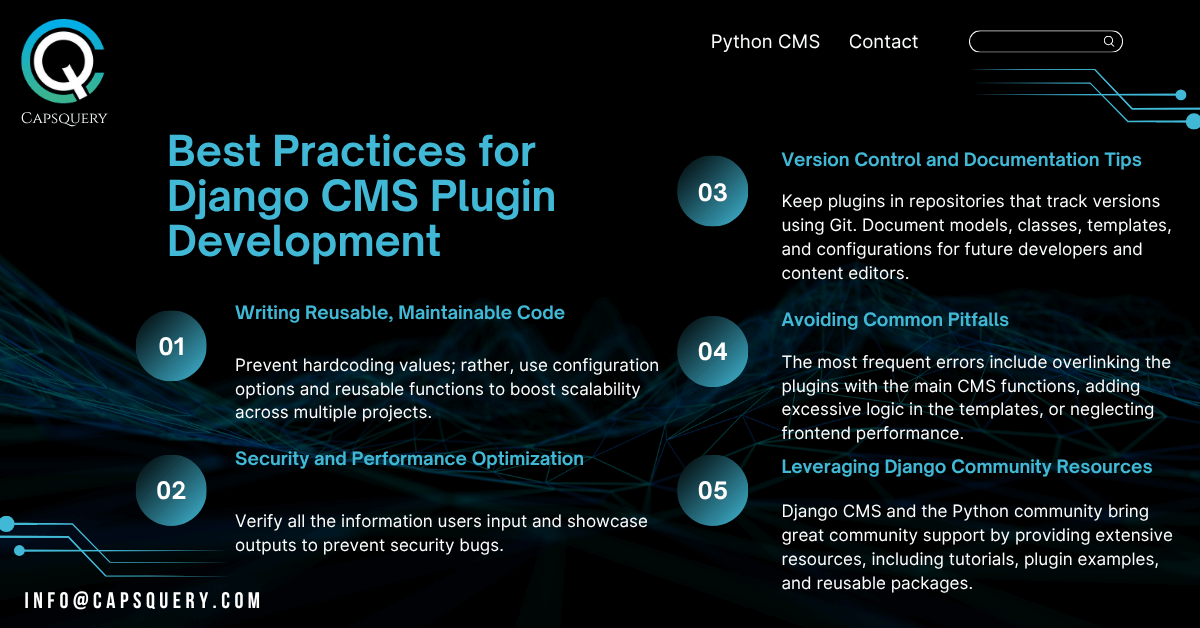
Build plugins with clear separation: models for data, plugin classes for behavior, and templates for rendering. Prevent hardcoding values; rather, use configuration options and reusable functions to boost scalability across multiple projects.
Verify all the information users input and showcase outputs to prevent security bugs. Utilize caching for frequently rendered plugin content that enhances page loading time.
Keeping an eye on plugin performance makes sure that CMS stays in check with responsiveness even during the peak traffic hours.
Keep plugins in repositories that track versions using Git. Document models, classes, templates, and configurations for future developers and content editors. Streamlined documentation cuts down onboarding time and leaves no room for gaps during updates.
The most frequent errors include overlinking the plugins with the main CMS functions, adding excessive logic in the templates, or neglecting frontend performance. Avoid these common gaps by implementing modular code and aligning Django CMS coding standards.
Django CMS and the Python community bring great community support by providing extensive resources, including tutorials, plugin examples, and reusable packages.
Using these resources means your plugin benefits from proven solutions and avoids reinventing the wheel.
Custom plugins extend Django CMS beyond standard content management. They support features for specific industries and help businesses grow.

Plugins can feature widgets that recommend products, custom checkout processes, or dynamic pricing dashboards, boosting sales and user experience.
Django CMS custom plugins can be used to create interactive course lists, quiz modules and student dashboards. This makes learning management simpler.
Plugins create dashboards for specific users, show analytics visually, and connect with third-party APIs. This makes subscription services better.
Custom content sliders, video galleries, and subscription forms engage audiences interested and support editorial work.
Plugins can handle metadata automatically, monitor users behavior, or add interactive elements like polls and surveys. This increases how much people engage and optimize content performance.
Python is what makes Django CMS work, and it gives developers amazing flexibility for building custom plugins. It’s simple and easy to read, which speeds up plugin development while maintaining robust functionality.
Python doesn’t lock you into specific types and has lots of built-in libraries. This helps developers handle complicated logic within plugins efficiently. Features like handling files, connecting to APIs, and processing data can be implemented with minimal boilerplate code. This makes Python perfect for adding to CMS extensions.
The Python and Django communities keep adding plugins, libraries, and solutions. Developers can use these to expand Django CMS quickly. They can put proven methods into custom plugin development. This cuts down on how long development takes.
Python supports quick iteration and testing that allow developers to build functional plugin prototypes, receive feedback, and optimize performance before launch. This boosts time to market faster and makes sure plugins match business goals.
Python’s clear way of writing and modular design rules make plugins easy to maintain, change, and grow. They work for both small startups and enterprise-level Django CMS websites.
Capsquery is a leading choice for Django CMS customization and Python CMS development services. Our team of developers helps brands utilize the full potential of plugin-driven websites. Our experience means every plugin adheres to both technical standards and business needs.
We excels at everything from designing custom plugins to building CMS solutions for enterprises. Capsquery offers end-to-end services, including designing architecture, developing plugins, connecting systems, and giving ongoing support.
Our exposure to key US markets makes us a proven choice for Django CMS customization services. We have served clients from Texas, Houston, Cupertino, San Jose, and Dallas. Our team excels at offering customized Django CMS solutions to startups, large companies, and agencies that want scalable websites with flexible modules.
Our custom plugins enhance site functionality without cutting corners on speed and security. At Capsquery, our team of experts builds reusable modules that ease the management of content-heavy sites. This allows businesses to align with the evolving business requirements.
Capsquery has delivered custom analytics dashboards, interactive forms, online store connections, and content management enhancements across varied industries. Our real-time project success showcases our ability to manage complex plugin requirements.
Our team is well-versed in Python CMS development. We ensure that every plugin fits smoothly with Django CMS. This helps win confidence for both developers and business leaders in long-term maintainability.
Custom plugin development in Django CMS is more than just a technical improvement. It’s a smart investment in flexibility, efficiency, and the ability to grow. When businesses use Python, they can make their CMS to handle dynamic content, interactive features, and advanced analytics while ensuring clean and maintainable code.
Whether it is about boosting user engagement, streamlining workflows, or building unique functionality, custom plugins allow companies to stand out in competitive markets.
Capsquery is the best custom web development company that excels at Django CMS, making us a trusted choice among businesses in Texas, Houston, Cupertino, San Jose, and more.
Our team of creative heads and dedicated developers creates custom plugins, scalable CMS platforms, and Python-powered solutions that bring real results.
If you are looking to maximize performance with Django CMS customization, our team offers you guidance, technical understanding, and hands-on development to turn ideas into reality. Count on Capsquery to transform your website into a dynamic, high-performance digital asset.
Website Development | Mobile App Development | Application Development
We will definitely get back in touch with you over mail within 12 Hours.
In-case you have not heard from us within 12 hours, kindly check your spam once.
I'm a software consultant. I've 7+ years of industry experience. I'd love to connect with you and brainstorm your custom software needs. It's my responsibility to find you the best solution.
ANAND GUPTA
Drop your details and we'll get in touch with you within 12 hours.
Reach us for

Talk to us