Oct
14
When working on web development projects, you do not want to compromise on CMS quality. With various CMS options on the line, Django CMS vs. Wagtail stands as the leading contender. From developers and startups to tech leads, they often find themselves confused about choosing the best Django CMS vs. Wagtail.
The reason both stand together is that both promise flexibility, scalability, and developer-friendly architecture with efficient content management.
It’s not about demeaning any of the CMS but choosing the one that perfectly aligns with business objectives, content strategy, and scaling-up strategies. Django CMS uses plugins for complex sites. Wagtail gives a modern developer experience and is made for advanced content modeling and headless applications.
At Capsquery, our team of expert developers integrates both Django CMS and Wagtail to develop custom, high-performing websites for clients across the US, including Texas, Houston, San Jose, and Dallas.
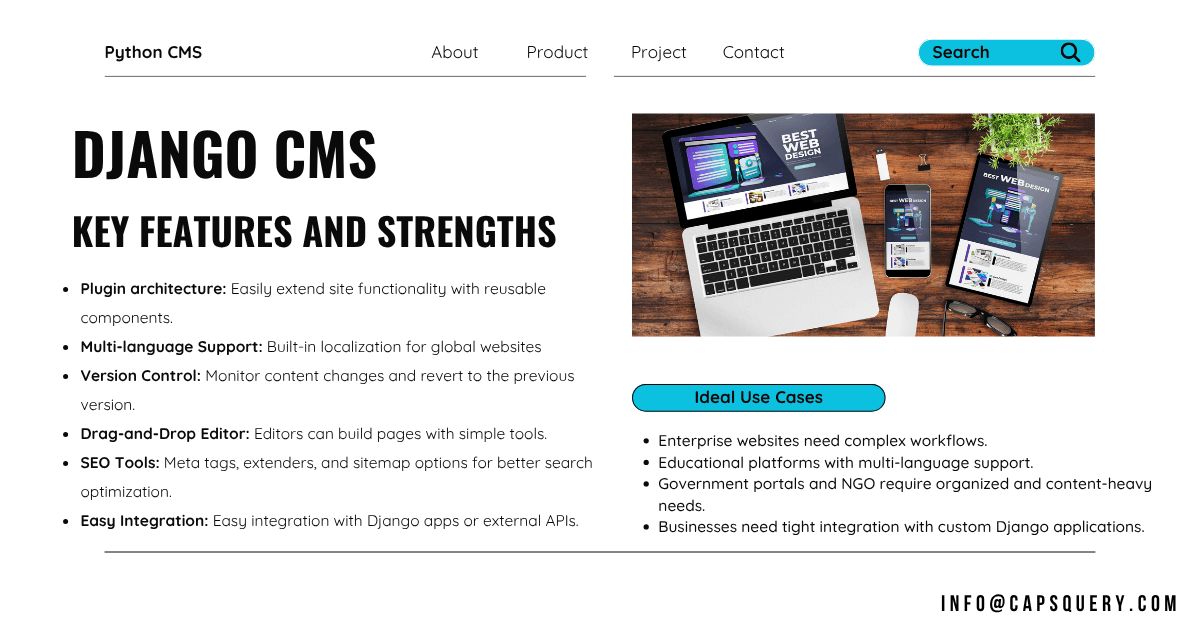
Django CMS is a plugin-powered CMS built using the Django framework. Plugins provide reusable components that enable developers to integrate rich functionality such as forms, galleries, or sliders without rewriting code. Plugin architecture is what makes Django CMS a standout choice for a modular, adaptable CMS that can exceed your business requirements.

Django CMS took its first step in the market several decades ago in 2007. Over time, it became popular for its flexibility and effectiveness in large enterprises. This is ideal for developers who seek a structured, extensible framework while providing a smooth interface for content managers.
Wagtail is also built on plugins, but it favors simplicity and a developer-oriented approach. Wagtail plugin “StreamField” allows developers to set up flexible content blocks for editors. This provides dynamic page structures without rigid templates.
Wagtail CMS was introduced by Torchbox in 2014. This CMS was designed to deliver a modern, lightweight alternative for developers and editors. It is simple to use, featuring a clean dashboard and strong developer resources, and it appeals to every enterprise, startup, and user who values ease, speed, and flexible design.
The decision between Django CMS and Wagtail involves aligning the platform with your project requirements, the skills of the team, and the nature of the content.
|
Feature |
Django CMS | Wagtail |
| Core Focus | Enterprise | Flexible |
| Editor | Drag & Drop | StreamField |
| Performance | Heavy | Fast |
| SEO | Built-in | Customizable |
| Headless | Limited | Native |
| Customization | Extensive |
Moderate |
Django CMS vs Wagtail stand head-to-head with some of the best differentiating factors. Here we have put together key differences between the two to make an ideal choice:
Django CMS is based on a modular, plugin-oriented architecture. This allows developers to develop custom plugins to extend functionality. Whereas Wagtail CMS uses the plugin StreamField, providing flexibility in structuring complex content blocks without relying on numerous plugins to create complicated layouts. Developers must choose depending on the project. They must determine which project demands plugin-driven extensibility or content-driven flexibility
Django CMS provides a drag-and-drop editor, which is ideal for non-technical managers. Developers may require a steeper learning curve due to plugin customization. On the other hand, the Wagtail editor interface is cleaner and developer-first, offering simplicity and code-driven content management. A development team prioritizing fast editorial adoption, Wagtail makes an ideal choice.
Django CMS is robust, yet when too many plugins and complicated logic are set up, performance may suffer. Wagtail is lightweight, optimized for faster page loads, and scales better than other systems. Growing projects or those expecting lots of traffic may find Wagtail’s speed more suitable.
Django CMS features built-in SEO tools and plugin support to enhance metadata, URLs, and content structuring. However, Wagtail comes with SEO features as well, but may depend on custom development for advanced marketing integrations. Businesses with active marketing needs often lean toward Django CMS, while tech-forward teams might choose Wagtail for flexible SEO handling.
Django CMS has a bigger Django community, with lots of plugins, guides, and resources. Wagtail’s community is smaller but active due to direct support from Torchbox. For large, long-term projects, Django CMS’s large user base gives more solutions, but Wagtail keeps up with fresh features and quick updates.
Both CMS rely on Django’s trusted security features. Django CMS updates regularly to meet enterprise standards. Wagtail focuses more on modern web security and compatibility for headless apps, fitting progressive and API-based websites.
Some projects truly benefit from Django CMS. Here’s when it’s the better-suited choice:
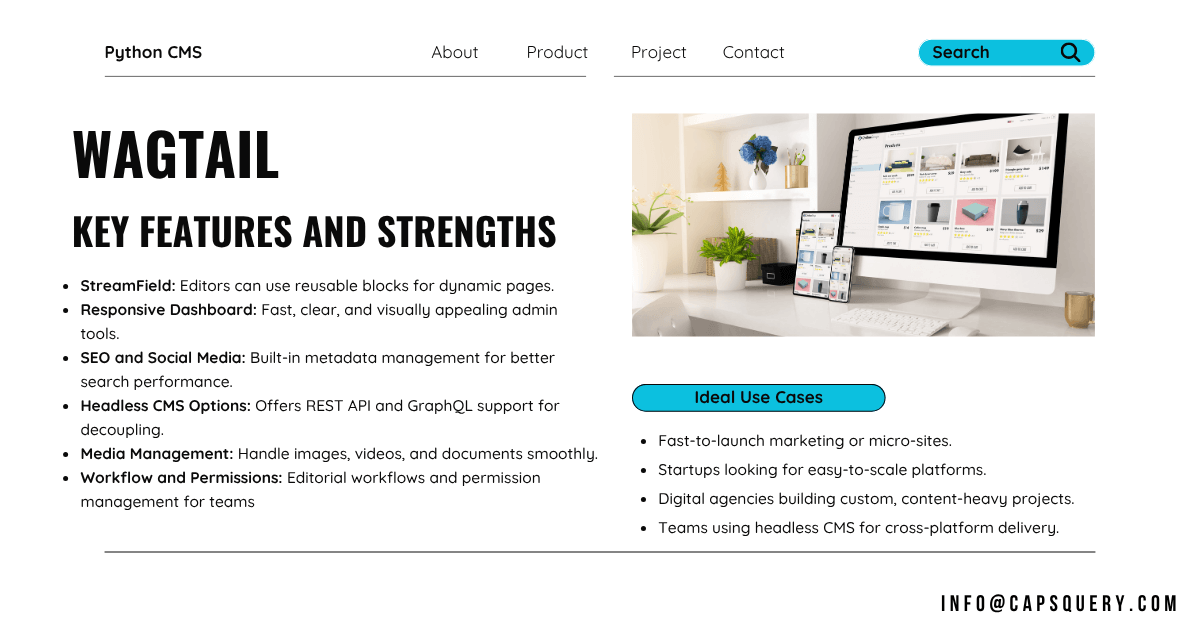
Wagtail stands out for speed, versatility, and editorial workflow improvements:
Explore how real-world performance helps in choosing the right CMS:
Wagtail shows better speed in busy, high-traffic setups thanks to its simple architecture. Django CMS supports robust, content-heavy portals with many contributors.
Django CMS follows familiar Django conventions with many plugins. However, complex setups may take more effort. Wagtail delivers developer-first flexibility and clean APIs, making content modeling quicker and cutting down on maintenance issues.
Updating and adding new features is simpler in Wagtail thanks to its structured content blocks and lightweight design. Django CMS, with many plugins, needs closer checks for compatibility during updates.
Capsquery is a custom web development company developing custom Python CMS platforms that grow as your business expands. Whether an enterprise portal or a media-rich site, our expert developers integrate both Django CMS and Wagtail to ensure your platform is fast, safe, and easy to use.
Serving clients in Texas, Houston, San Jose, and Cupertino, we focus on solutions that support your goals and boost ROI.
We cover everything from initial design, plugin setup, and headless CMS configuration to SEO optimization. Your site is future-proof and technically strong.
Our projects from Houston to Cupertino showcase clear results, faster pages, better content handling, and reliable scalability.
Our team builds plugins, models content, and optimizes SEO and integrations. Your CMS fits your business needs and supports long-term growth.
Our team of experts adhere to clean coding practices, modular architecture, and modern frameworks. This makes future updates and maintenance simple and efficient
After we have deployed the development project, we provide ongoing support, frequent security upgrades, and CMS upgrades to ensure that your website is running smoothly.
Choosing the Python CMS is a major step towards project success. Django CMS is an excellent choice for complex, business-level websites that require extensive integration of the plug-in component and multilingual functionality. Wagtail is unique in having developer-first tools, speed and headless CMS options.
At Capsquery, we specialize in both the CMS platform and offering custom solutions for US-based businesses. Whether you need robust workflows or a quick and scalable headless system, our team matches CMS solutions to business goals and website performance needs.
Reach out to Capsquery today to develop a modern Django or Wagtail-powered website with unmatched expertise and performance.
Website Development | Mobile App Development | Application Development
We will definitely get back in touch with you over mail within 12 Hours.
In-case you have not heard from us within 12 hours, kindly check your spam once.
I'm a software consultant. I've 7+ years of industry experience. I'd love to connect with you and brainstorm your custom software needs. It's my responsibility to find you the best solution.
ANAND GUPTA
Drop your details and we'll get in touch with you within 12 hours.
Reach us for
Talk to us