Nov
3
Ecommerce platforms lay the groundwork for success in an online store. Select the platform that offers the most optimal user experience for customers. With the battle between top players like Django Oscar vs Saleor vs Shopify, it becomes challenging to rely on one that can perfectly meet your online store development requirements.
Choosing the best doesn’t end with features; you must also consider flexibility, scalability, and long-term growth. Django is a leading e-commerce framework allowing you to build a highly customizable and clean store design. Whereas Saleor is a headless, GraphQL-first e-commerce platform that allows you greater flexibility in developing custom storefront experiences. Both Django Oscar and Saleor are Python-based, allowing you to customize any design and element.
However, Shopify is an e-commerce platform that enables you to create an online store with a highly customizable theme. With Shopify, you may be limited in customization at some point, but Django Oscar gives you a free hand for customization.
So, which platform may be best for you: Django Oscar vs Saleor vs Shopify? Keep reading to find out.
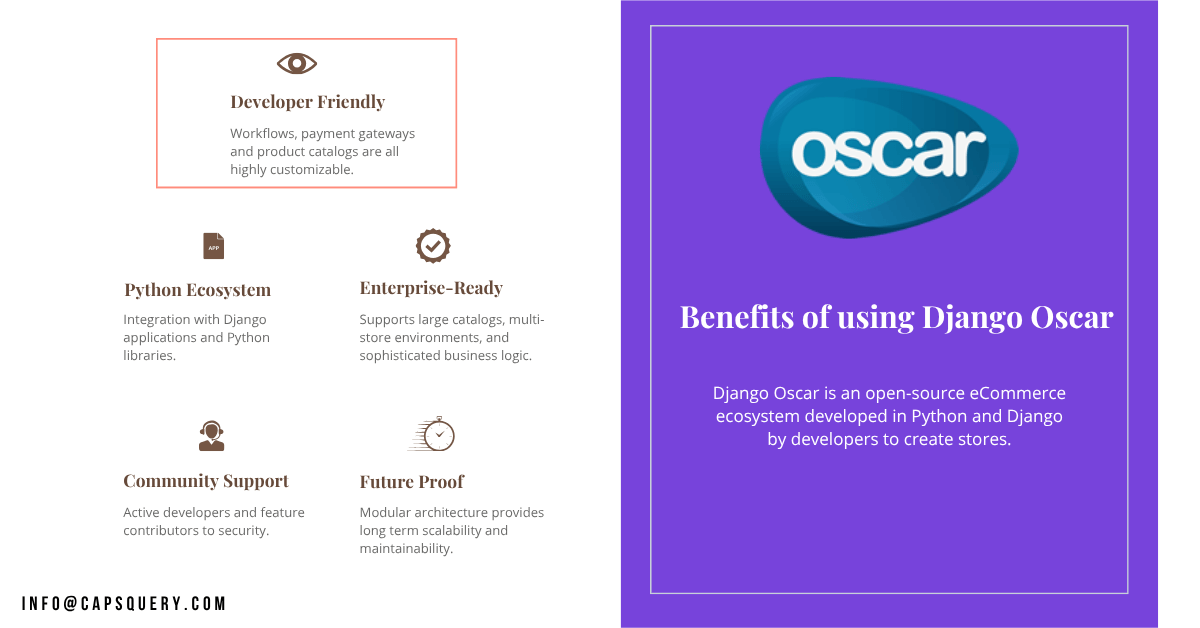
Django Oscar is an open-source eCommerce ecosystem developed in Python and Django by developers to create stores. The system is designed to provide developers with a space to work and maintain order while also being capable of expansion.
Companies also have the opportunity to create their own individual online stores without necessarily bumping the walls that platforms erect. Its robust architecture supports both B2B and B2C, which is why it is relevant to large companies or projects and requires numerous custom-made features.
Saleor is an open-source eCommerce platform that uses GraphQL for headless commerce and JAMstack integration. The Saleor framework is built on Python and Django, enabling developers to create fast and scalable online stores.
Using API-first architecture, it offers flexibility in frontend design and omnichannel delivery, making it an ideal solution for startups and digital-first brands.

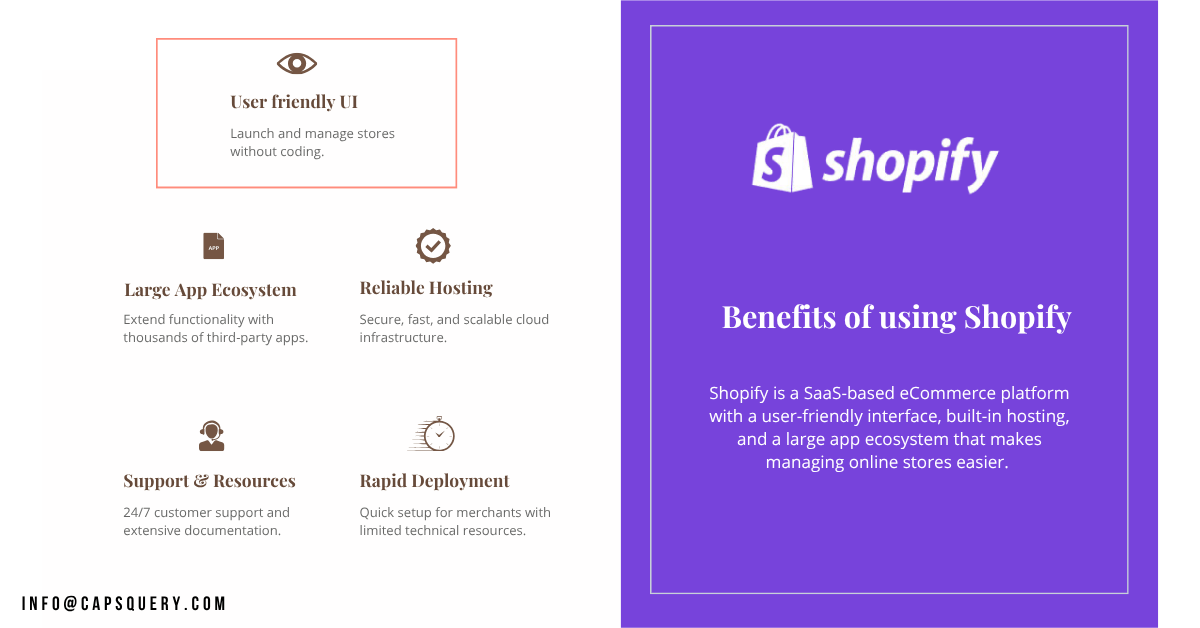
Shopify is a SaaS-based eCommerce platform with a user-friendly interface, built-in hosting, and a large app ecosystem that makes managing online stores easier. It is popular among small and medium-sized businesses, as it can be started quickly without requiring technical expertise. The platform takes care of the complex technical aspects, allowing merchants to focus on selling, marketing, and customer support.
Considering all the benefits and use cases of various ecommerce platforms, you may be confused about choosing the best one for your business. Choose the best, which is not just great in the book but also in real time. Therefore, we have put together key differences between Django Oscar vs Saleor vs Shopify to choose the best for your online store with a great interface.
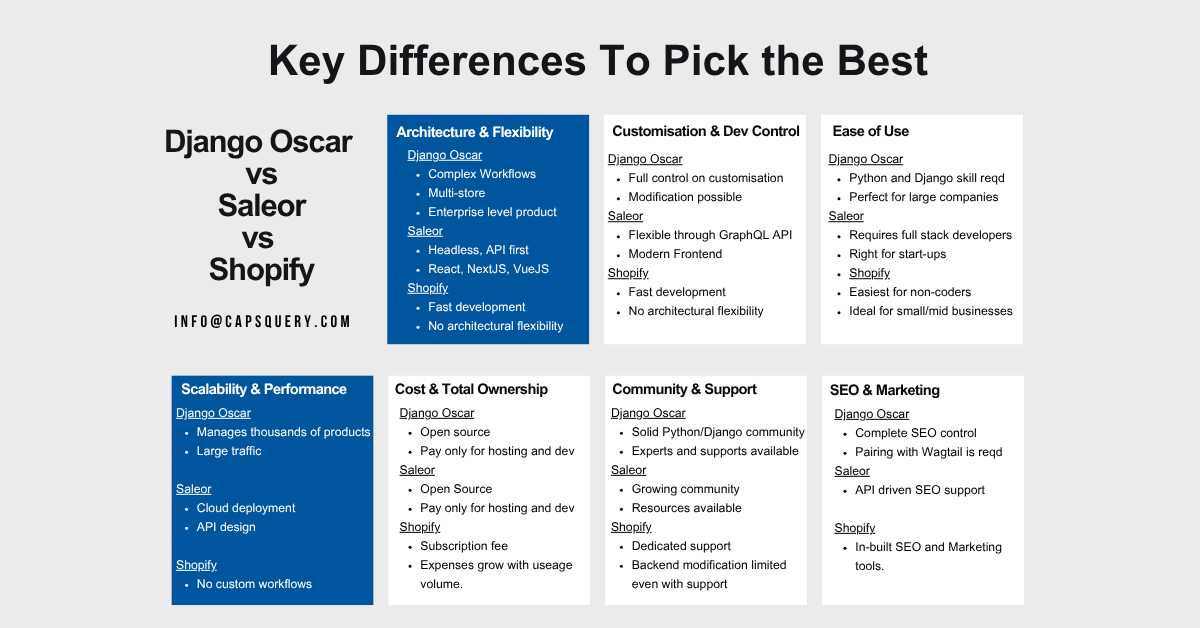
Django Oscar uses a modular Python and Django structure. It manages complex workflows, runs multiple stores, and handles enterprise-level product lists. The way it’s organised allows developers to modify any part of the store, from checkout steps to product structure.
Saleor takes a headless, API-first approach. Front-end developers can use React, Next.js, or Vue to build the interface they envision. Shopify runs entirely as SaaS, which means the backend processes are abstracted. Shopify allows for fast deployment but cuts down architectural flexibility; that is why it is less useful for large businesses with complex and unique element requirements.
Django Oscar offers developers complete customization options and full control. They can extend models, create custom promotions, and modify the admin panel as needed. Saleor offers flexibility through GraphQL API, which works great for modern frontend work, but you might need extra development for some backend features.
Shopify enables you to personalize using themes and apps. This is handy yet constrained compared to open-source solutions, particularly when companies require specific workflows or special integrations.
People without coding skills will find Shopify easiest. You can drag and drop to set things up and choose from ready-made templates; the interface is intuitive and easy to use right away.
Saleor needs developers who are familiar with both backend and frontend development. Djnago Oscar requires the core technical skill, as you need to understand Python and Django, and it also takes time to set up.
This makes Shopify ideal for small and medium-sized businesses, Saleor right for startups with tech-savvy teams, and Oscar perfect for large companies with their own in-house development staff.
Django Oscar handles enterprise needs well. It can manage thousands of products, run multiple stores, and handle a large number of visitors. Saleor grows nicely with cloud deployment and its API design, especially for headless setups or selling across many channels. Shopify works well for small to medium-sized businesses; however, if you require large-scale, custom workflows, you will encounter limitations.
Django Oscar is open-source, so you mainly pay for development and hosting. Saleor is also open-source and offers optional cloud hosting, whereas Shopify charges subscription fees, transaction fees and even for paid apps, which makes it even more complicated for business owners.
These expenses grow over time, particularly for bigger stores. Shopify saves you technical work, but open-source frameworks are often less expensive in the long run for enterprise stores.
Django Oscar has a solid Python/Django community. This makes finding experts, support and resources easier. Saleor’s community is growing, particularly among developers who work with modern frontends and headless systems.
Shopify offers dedicated support, forums, and numerous apps, but you still can’t modify the backend extensively.
Oscar lets you control SEO and marketing integrations completely, especially when paired with Wagtail for content-driven eCommerce. Saleor supports API-driven SEO for headless frontends, giving developers room to optimize things their way. Shopify includes SEO tools and marketing apps already built in, but you don’t get the same backend control and customization options.
| Feature | Django Oscar | Saleor | Shopify |
| Customization | Extensive, modular Python/Django architecture | High via GraphQL API, headless approach | Limited, template-based, some code-level customization |
| Ease of Use | Developer-heavy setup | Requires frontend dev skills | Very easy, plug-and-play |
| Scalability | Enterprise-grade, multi-store capable | Cloud-native, API-first | Medium, Shopify Plus needed for large-scale |
| Cost | Open-source, hosting/dev costs | Open-source, optional cloud costs | Subscription fees, app costs |
| Community/Support | Active Python/Django community | Growing modern dev community | Dedicated 24/7 support, large app ecosystem |
| SEO & Marketing | Full control, integration with CMS | API-driven SEO flexibility | Built-in SEO, marketing apps |
Django Oscar works best when businesses require a robust, customizable platform that leverages Python. The way it’s built in modules and its enterprise capabilities make it right for large-sized online stores.
Enterprises, B2B companies, large catalogues, and content-rich stores that integrate CMS platforms like Wagtail.
Saleor is the leading choice for store owners seeking modern, headless, API-first e-commerce solutions. It’s designed for developers who need speed, flexibility, and the ability to sell across multiple channels.
Startups, headless commerce enthusiasts, and cloud-native eCommerce projects.
Shopify does well at being simple and fast. Merchants who want to launch quickly without dealing with technical details should consider it.
Small to medium-sized businesses, fast go-to-market strategies, seasonal or campaign-driven stores.
Choosing a reliable e-commerce platform depends on the size of your business, the level of technical support you require, and the long-term approach you want to take. Saleor and Shopify are good options, but Django Oscar is the best choice when companies and developers require flexibility, growth opportunities, and full control over development.
Teams with Python and Django skills should look at Django Oscar first. The modular structure lets you customize workflows, product models, and checkout systems without limits. Saleor provides developers with flexibility, but it requires a modern frontend setup. Shopify’s SaaS design restricts you from making significant changes to the backend.
Businesses that combine a large amount of content with product sales should consider using Django Oscar + Wagtail CMS. You can manage big catalogs, complex workflows, and marketing content all in one place. Saleor handles content through APIs, but it doesn’t come with a built-in CMS. Shopify’s content features are basic and often require additional apps.
Django Oscar manages multiple stores, B2B pricing, detailed reporting, and thousands of products. Saleor may require additional development for these workflows. Shopify depends on apps and integrations, which can be limiting.
Startups building headless commerce will find Saleor’s API-first design appealing. Django Oscar can also work headlessly, but requires more setup. Shopify wasn’t built for headless use, and it provides less flexibility for modern frontend experiments.
Shopify lets you launch fast without technical work. However, as your business grows, you will likely notice that customization limitations and app dependencies become issues. Django Oscar requires initial development, but it offers long-term growth potential and full ownership.
Django Oscar’s open-source means you have complete control and can prepare for the future. You can expand your catalog, enhance workflows, and incorporate advanced tools without vendor restrictions. Saleor offers similar flexibility but requires frontend expertise. Shopify locks you into subscriptions and limits your backend access.
Choosing between Django Oscar vs Saleor vs Shopify determines how your business grows, scales, and delivers experiences to customers. Django Oscar comes out ahead for enterprises and teams that rely on developers. It offers unmatched flexibility, handles complex workflow management, and works smoothly with Python tools. Saleor suits startups exploring headless commerce, while Shopify is ideal for small businesses seeking speed and flexibility. But neither matches what Django Oscar can do at the enterprise level.
Want a seamless experience that combines content and commerce? Our team of experts has expertise in Django Oscar with Wagtail to build an eCommerce platform that performs well and grows with your business. Explore how the approach works.
Website Development | Mobile App Development | Application Development
We will definitely get back in touch with you over mail within 12 Hours.
In-case you have not heard from us within 12 hours, kindly check your spam once.
I'm a software consultant. I've 7+ years of industry experience. I'd love to connect with you and brainstorm your custom software needs. It's my responsibility to find you the best solution.
ANAND GUPTA
Drop your details and we'll get in touch with you within 12 hours.
Reach us for

Talk to us