Sep
17
You are impressed with Python. As you have heard countless times, Python-based websites are ideal for data analysis and reporting. However, when it comes to eCommerce platforms, you continue to encounter the same advice: pick WordPress or WooCommerce, as they are easy, cheap, and popular. Yet, solutions like Wagtail Django Oscar offer a more flexible and scalable Python-powered alternative for building robust online stores.
It may be tempting, but the problem is that WordPress/WooCommerce is not Python. If you intend to achieve a seamless, Python-native setup where content, products, and data interplay smoothly, settling for anything less seems like a compromise.
That’s where Wagtail and Django Oscar come in. Together, they provide a complete alternative to WordPress/WooCommerce, containing everything your store needs, and all built using Python.
As with WordPress/WooCommerce, you can host your products on your own server without incurring any hidden fees. This system gives you complete control, scalability, and the capacity to grow your business as it grows.
Keep reading to explore the ways to use Wagtail Django Oscar for a seamless eCommerce experience.
Imagine your marketing lead needs to publish a “Holiday Gift Guide” blog post with embedded images, related product links, and an SEO-friendly layout. In a traditional setup, they’d email developers for help. With Wagtail, a premier Python CMS, your team skips this step. They log into a clean, intuitive dashboard and use drag-and-drop components to build pages.
Here are some of Wagtail Python CMS perks people are talking about:
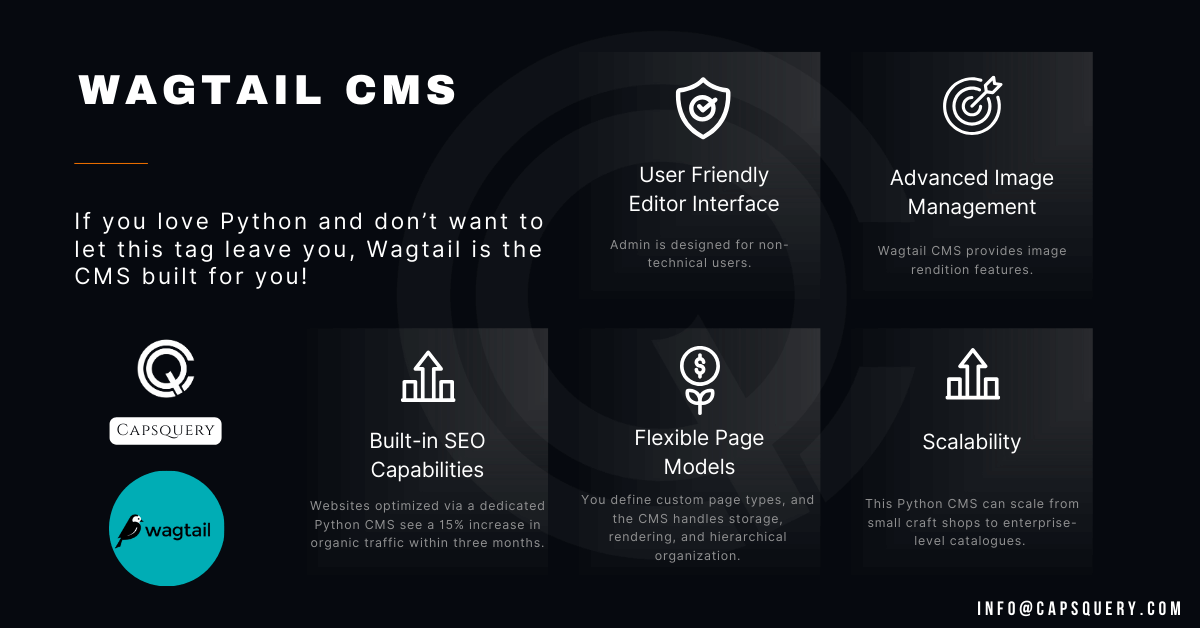
Admin is designed for non-technical users. Even team members unfamiliar with HTML can create, preview, and publish content. This speeds up campaign launches.
Each page comes with meta fields (titles, descriptions, and canonical URLs.) Why is it beneficial? Well, research indicates that websites optimized via a dedicated Python CMS see a 15% increase in organic traffic within three months.
Whether you need a “Product Detail” page, a “Category Overview,” or a “Blog Post,” page modelling system adapts. You define custom page types, and the CMS handles storage, rendering, and hierarchical organization.
High-quality visuals are crucial in eCommerce. Wagtail CMS provides image rendition features, from automatic resizing and cropping to format conversion. Thus ensuring product images load fast on desktop and mobile.
This Python CMS can scale from small craft shops to enterprise-level catalogues. Suppose you start with 100 products and grow to 10,000 SKUs by next year; its architecture accommodates that growth without sacrificing performance.
Want to know more? Here’s a quick guide.
While Wagtail CMS focuses on content, Django Oscar, a specialized Django CMS eCommerce framework, powers your store’s core functions. These include but are not limited to the product catalogue, shopping cart, checkout, and order management. Thanks to its modular design, Django Oscar delivers a robust, customizable foundation tailored to your unique requirements.
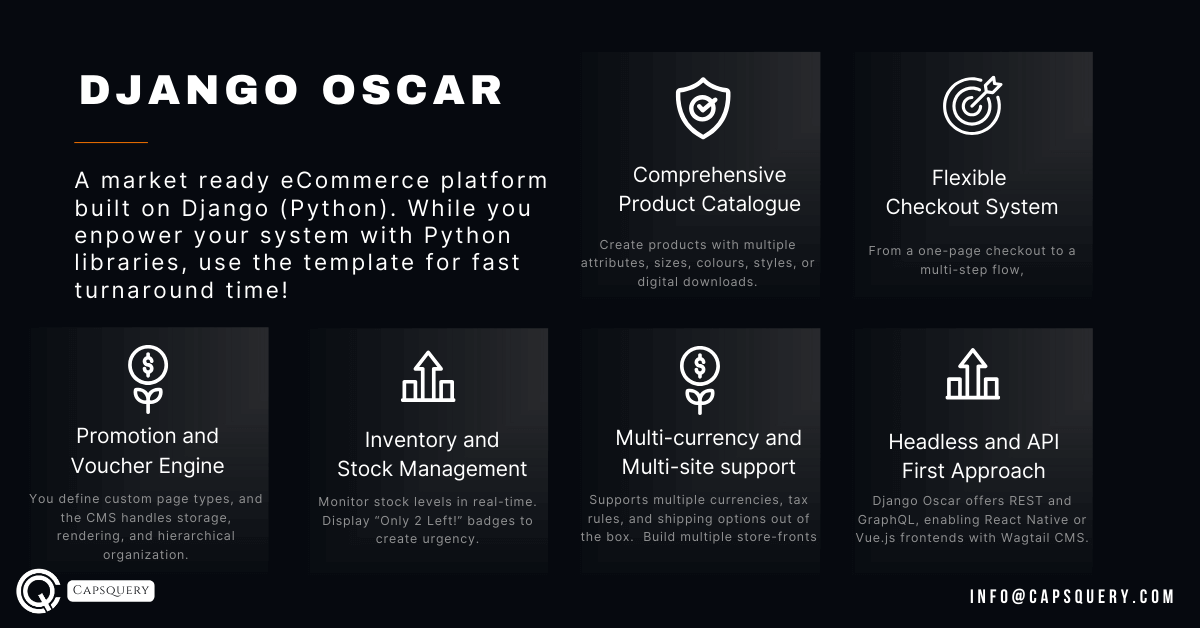
Django CMS allows you to create products with multiple attributes, sizes, colours, styles, or digital downloads. You can group products into categories, set up bundled offers, and manage variants with ease.
Whether you need a one-page checkout or a multi-step flow, Django Oscar’s pipeline architecture lets you customize every stage.
Launch time-limited discounts, BOGO (Buy One, Get One) deals, or tiered pricing without additional coding. This “offers” framework lets you mix and match promotional rules while providing clear redemption reporting.
Monitor stock levels in real-time. When stock dips below a threshold, Django Oscar can trigger automated notifications or display “Only 2 Left!” badges to create urgency.
Selling globally? Django Oscar supports multiple currencies, tax rules, and shipping options out of the box. You can run multiple storefronts, each with distinct domain names, off a single codebase, reducing operational overhead.
If you want to build a mobile app or a decoupled storefront, Django Oscar exposes REST and GraphQL endpoints. That means your developers can build a React Native or Vue.js front end while Wagtail CMS handles content. Customers enjoy lightning-fast and dynamic experiences.
Want to know more? Here’s a quick guide.
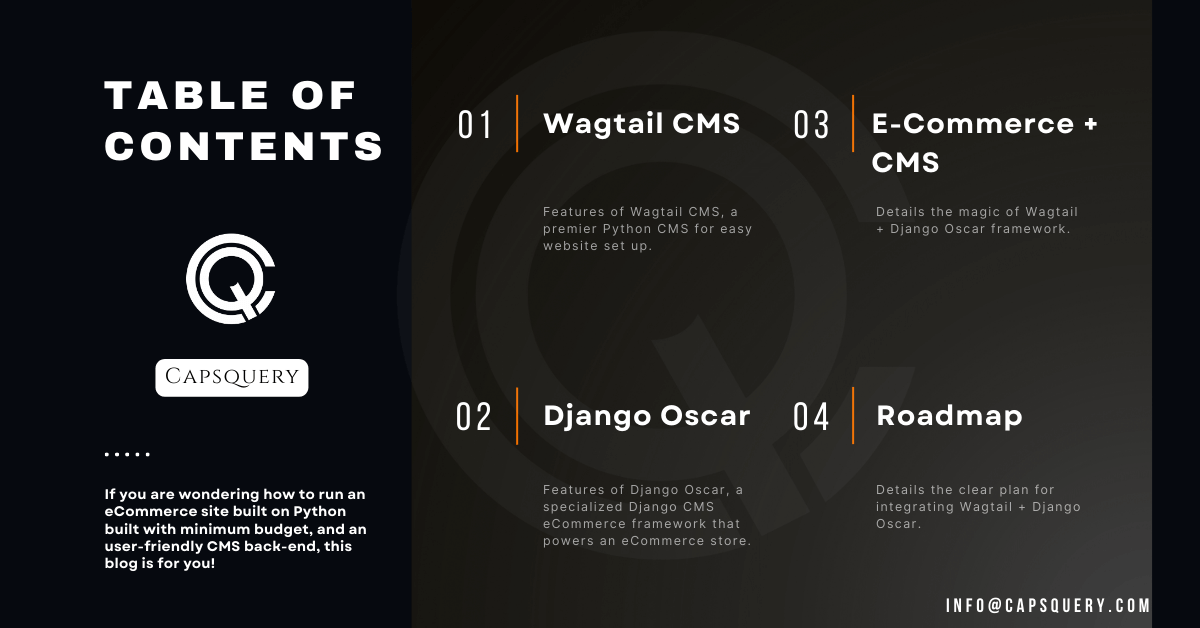
Yes, Wagtail and Django CMS are powerful frameworks. However, the magic happens when they share data models and an admin interface. Here’s how they collaborate to create a truly unified eCommerce platform:
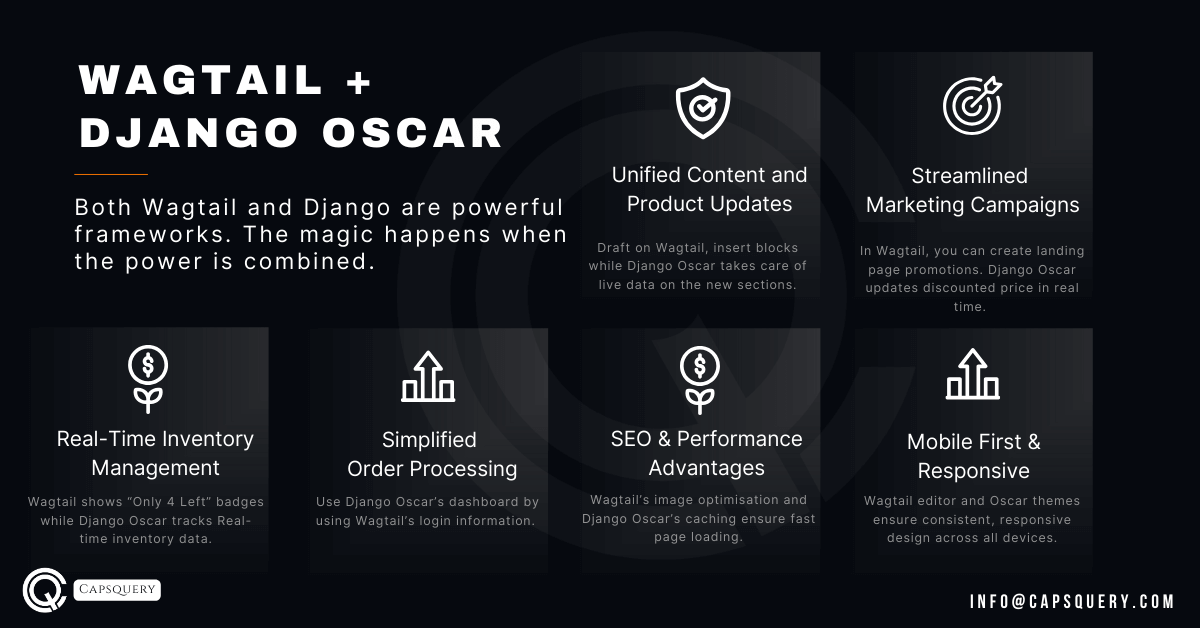
You draft a “New Arrivals” blog post in Wagtail, insert a “Related Products” block that automatically pulls live data from Django Oscar’s catalogue, and hit “Publish.” No more emailing developers or juggling spreadsheets.
Launching a “Flash Friday” promotion? In Wagtail, you create a landing page with a “Product Carousel” component, filter products tagged “Flash Friday,” and publish. Django Oscar updates discounted prices in real-time.
As orders arrive, Django Oscar updates stock levels. Wagtail shows “Only 4 Left!” badges, creating urgency; research indicates low‑stock messaging can boost conversions by up to 12%.
Operations staff view new orders, update shipping statuses, and print packing slips, all from Django Oscar’s interface, accessible via the same Wagtail login. Priority orders get flagged, and customers receive automated notifications.
Wagtail’s image optimization and Django Oscar’s caching ensure pages load in under three seconds. Google reports that faster sites can see up to 15% higher organic traffic.
In 2024, over 55% of eCommerce traffic came from mobile devices. Wagtail’s responsive editor guarantees marketing updates look great on any screen, while Django Oscar’s storefront themes automatically adapt, delivering a consistent experience across smartphones, tablets, and desktops.
By combining content and commerce under one roof with a Python CMS, your marketing, design, and operations teams collaborate more effectively. You spend less time coordinating tasks and more time focusing on strategy, product innovation, and refining your brand’s voice.
Now that you understand the why and how, let’s outline a clear plan for integrating Wagtail and Django Oscar into your eCommerce business:
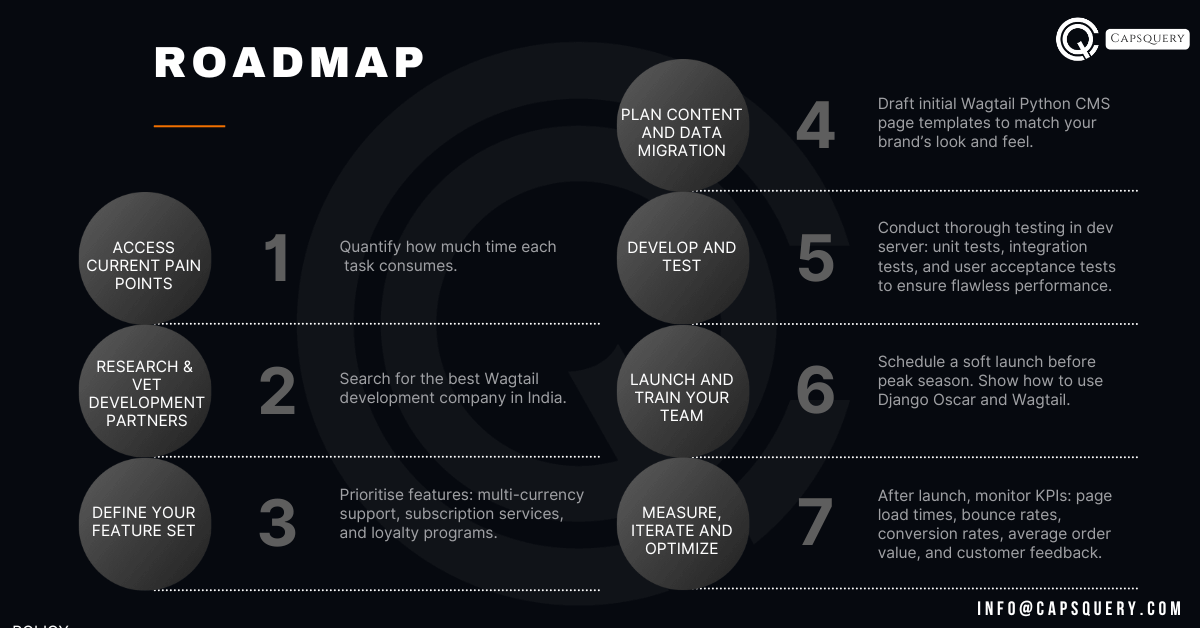
List tasks that require multiple tools: content updates, product edits, order management, or promotional campaigns. Quantify how much time each task consumes.
Search for the best Wagtail development company in India or your region. Verify their expertise with Wagtail, Django, and Python CMS eCommerce frameworks. Review portfolios and client testimonials.
Prioritize features: multi-currency support, subscription services, and loyalty programs. Determine if you need headless capabilities for future mobile apps or third-party integrations (e.g., ERP, CRM, advanced analytics).
Inventory existing content: blog posts, landing pages, and product descriptions. Outline a migration strategy, automated scripts, or manual rewrites. Draft initial Wagtail Python CMS page templates to match your brand’s look and feel.
Your development partner sets up a staging environment. They integrate Wagtail CMS and Django Oscar, configure data models, and implement custom features (e.g., advanced discount rules). Conduct thorough testing: unit tests, integration tests, and user acceptance tests to ensure flawless performance.
Schedule a soft launch before peak season. Provide live and recorded training sessions: show marketers how to use Wagtail’s editor and walk operations staff through Django Oscar’s order dashboard. Create quick-reference guides for tasks like “Adding a New Product,” “Publishing a Blog Post,” and “Creating a Promotional Offer.”
After launch, monitor KPIs: page load times, bounce rates, conversion rates, average order value, and customer feedback. Use integrated analytics (Google Analytics, custom dashboards) to identify areas for improvement. For example, if your “Featured Products” section isn’t converting, test different layouts or calls-to-action.
Choosing a combined solution of Wagtail CMS and Django Oscar equips you with a modern Python CMS and a feature-rich Django CMS eCommerce framework that operates in harmony. You’ll streamline content publishing, simplify product management, and deliver a seamless shopping experience. Thus ensuring your store stays competitive in 2025 and beyond.
When you’re ready to embark on this transformation, look for the best Wagtail development company in India. They should have a proven track record in both content-driven and commerce-driven Django and Wagtail CMS projects. With the right expertise, you’ll minimize development time, reduce maintenance headaches, and empower your team to focus on strategic growth.
Website Development | Mobile App Development | Application Development
We will definitely get back in touch with you over mail within 12 Hours.
In-case you have not heard from us within 12 hours, kindly check your spam once.
I'm a software consultant. I've 7+ years of industry experience. I'd love to connect with you and brainstorm your custom software needs. It's my responsibility to find you the best solution.
ANAND GUPTA
Drop your details and we'll get in touch with you within 12 hours.
Reach us for
Talk to us