Feb
24
Backend technology choices are no longer technical. As a founder, CTO, or someone in charge of product development, the question of Node.js vs Python strikes your bottom line how your app performs, how much it costs to scale, how quickly you can hire, when you launch, and how much you will spend in the long-term. The technologies that power millions of modern applications solve a wide range of problems.
Companies throughout the US, Cupertino, Texas, Houston, Dallas, keep asking the same thing: which stack actually works for what we’re building and where we’re headed?
Node.js delivers high performance and handles a massive number of connections through its event-driven design. Python keeps code simple, runs most data science operations, and ships features quickly. We’re going to walk through Node.js vs Python on performance, growth capacity, design philosophy, practical applications, and business fit.
Node.js is a cross-platform, open-source runtime, written in JavaScript and powered by the V8 engine of Chrome. JavaScript is the language developers use to write server-side code, so they can write both client and server code in the same language. Node.js processes requests without blocking anything, using events to manage operations efficiently.
Older servers create a fresh thread per request. Node.js doesn’t work that way. It is a single-thread event-loop-based approach, killing efficiency when it comes to I/O and live data processing. That architecture is why Node.js replaced modern backend applications, smaller service applications, and APIs, which require expansion.
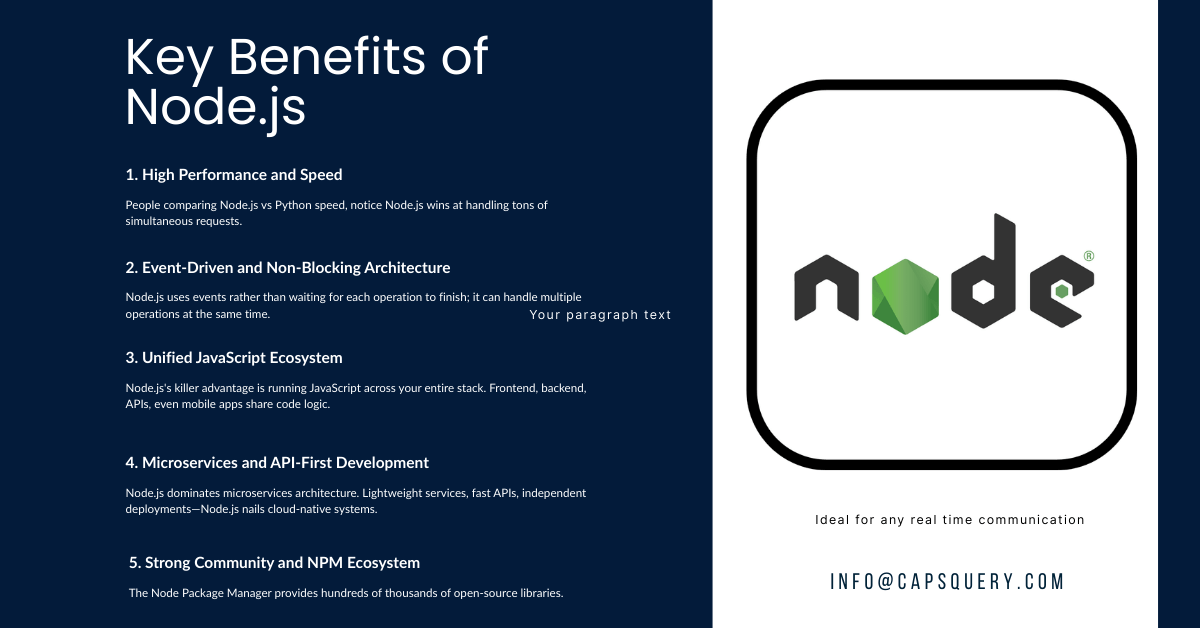
People comparing Node.js vs Python speed notice Node.js wins at handling tons of simultaneous requests. The V8 engine executes JavaScript blazingly fast, and since nothing blocks, you skip the slowdowns that plague traditional servers. Node.js dominates when apps move data instantly, stream content, or hammer APIs constantly.
Node.js crushes these scenarios:
Companies building speed-critical systems see Node.js backend development deliver faster responses and squeeze more from their infrastructure. Such performance advantage is driving dozens of startups and SaaS enterprises to Node.js as soon as they start.
Node.js uses events rather than waiting for each operation to finish; it can handle multiple operations at the same time. Rather than blocking threads, Node.js registers callbacks and keeps executing other work.
This design dominates for:
In Node.js vs Python backend comparisons, Python processes things in order unless you explicitly specify behavior as asynchronous. Likewise, Node.js is non-blocking by default, making it the clear choice when a high concurrency level with minimal lag is required.
Node.js’s killer advantage is running JavaScript across your entire stack. Frontend, backend, APIs, even mobile apps share code logic. Development time decreases, and teams collaborate more easily.
Startups get:
Looking at Node.js vs Python for startups, this unified ecosystem tips decisions toward Node.js when speed and flexibility beat complex computation.
Node.js dominates microservices architecture. Lightweight services, fast APIs, independent deployments—Node.js nails cloud-native systems.
Node.js pairs perfectly with:
Companies building platforms that evolve without monolithic constraints choose Node.js.
The Node Package Manager provides hundreds of thousands of open-source libraries. Development effort drops and feature implementation accelerates.
You get:
Enterprises which employ Node.js engineers in Houston or Dallas are enjoying an ecosystem that guarantees long-term stability and innovative thought processes.

Python is an interpreted and high-level language that is known to be readable, simple, and versatile. It allows a variety of programming styles: procedural, object-oriented, functional. Python is used in the development of backend, data science, AI, automation as well as scientific computing. In contrast to Node.js, Python has been traditionally a synchronous language, but current frameworks allow operation asynchronous. Comparing Python and Node.js, Python is the preferred choice in data-driven and enterprise applications due to its breadth of ecosystem and developer’s ease of development.

The syntax of Python remains readable and clear, and it allows the developers to write less code to get the complex functionality. This simplicity makes development faster and reduces the maintenance cost.
Businesses experience:
When clarity and long-term stability are more important than raw speed, Python is the ultimate winner in Python vs Node.js which is better debates.
Python has a grip on AI, machine learning and data analytics. Python is impossible to defeat by libraries such as TensorFlow, PyTorch, Pandas, and NumPy in creating intelligent systems.
This separates Python in Node.js vs Python for enterprise applications, especially businesses building:
Python frameworks like Django and Flask deliver structured, secure, scalable backend development.
Key advantages:
Python excels for Python REST API development and long-term platforms.
Python can be deployed to large businesses because it is stable and has rich tooling. Python is used in large organizations as a backend service, automation, and analytics. Python competes strongly in Node.js vs Python scalability discussions for enterprises.
Modern Python frameworks support asynchronous programming through async/await. Although it is not as native as Node.js, Python is able to support workloads that are run concurrently. This bridges the Node.js and Python differences in performance in most real-world applications.

| Factor | Node.js | Python | Best Fit |
| Performance | High for I/O | Moderate | Node.js |
| Scalability | Event-driven | Process-based | Node.js |
| AI & Data | Limited | Excellent | Python |
| Learning Curve | Medium | Easy | Python |
| Real-Time Apps | Excellent | Good | Node.js |
When it comes to deciding between Node.js and Python, it is not about proclaiming either of the two technologies to be better than the other. They are different in terms of their architectural methods, performance, scaling plans, and tooling ecosystems. These variations directly affect the rate of development, system dependability, human resource policy and the cost-effectiveness of startups and businesses in the long term.
Now we are going to break down the key distinctions that are important in real backend development.
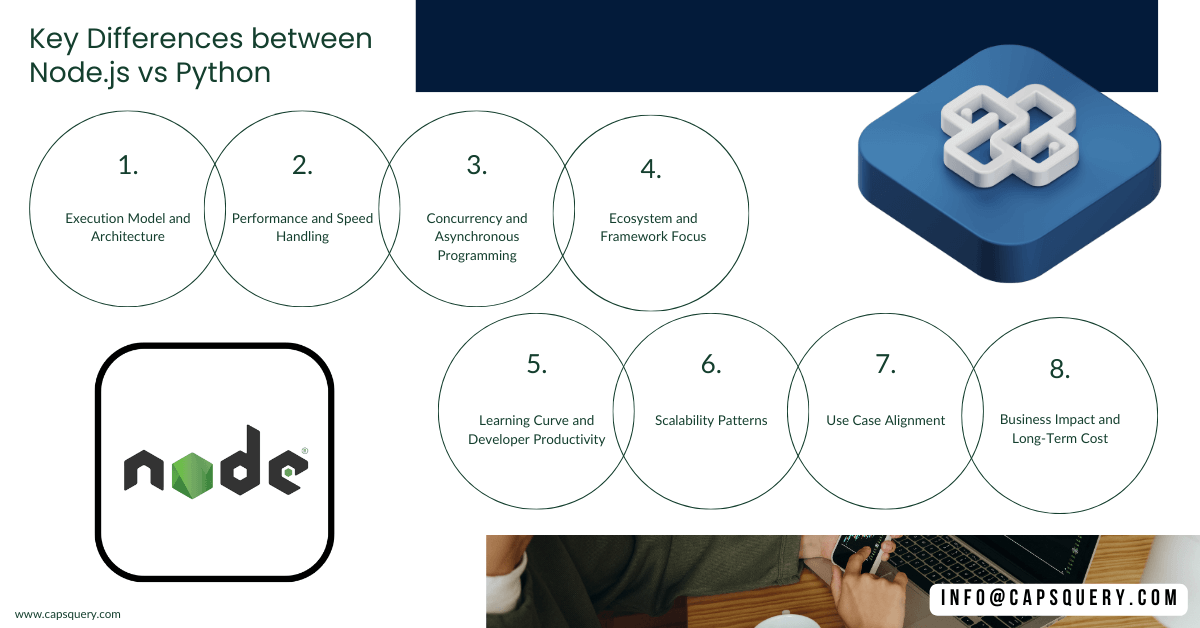
Code execution is the basic where the differences between Node.js and Python lie. Node.js has single-threaded, event-driven non-blocking architecture. It is also able to manage thousands of simultaneous connections without creating new threads per request. Python uses default multi-threaded (or multi-process) models of synchrony, but has also the frameworks of asynchrony.
Key implications:
This architectural difference heavily influences performance and scalability decisions.
A comparison between Node.js and Python performance reveals that Node.js usually performs better than Python in terms of applications where there is a high frequency of network calls, streaming, or real-time updates. Node.js is an open source implementation of JavaScript, which is powered by the V8 engine by Google and does not block operations. Python is by default interpreted and synchronous, and therefore is slow when loaded concurrently unless optimized.
Performance comparison highlights:
Node.js becomes the strong choice for speed-sensitive web applications.
Node.js supports concurrency, implementing asynchronous programming via callbacks, promises, and async/await. Python is an asynchronous language with optional support, so it may need a dedicated framework like asyncio, FastAPI, or Tornado to use.
Key differences:
In the case of high traffic of concurrent users, Node.js offers a superior experience.
The ecosystems of Node.js and Python developed based on varying priorities. Express, NestJS, and Fastify are node.js frameworks that put much emphasis on API-first, microservices, and real-time systems. Python frameworks, such as Django and Flask, focus on such aspects as structured development, security, and stability.
Ecosystem comparison:
This disparity affects the application building, scaling, and maintenance.
Python is among the programming languages that are easy to learn. Its syntax remains concise, comprehensible and user-friendly. Although strong, Node.js forces developers to have knowledge of asynchronous patterns, event loops, and handling of callbacks that may be difficult to learn.
Developer experience differences:
This would have a direct impact on the hiring, costs of training, and development schedules.
When it comes to Node.js vs Python scalability, the Node.js is frequently favored in horizontally scalable systems such as microservices and cloud-native applications. Python is also efficient in scaling, which is typically performed by vertical scaling or process-based scaling using Gunicorn or Celery.
Scalability considerations:
The proper decision will be determined by anticipated traffic and system structure.
Node.js and Python are bright in various areas of problems. Node.js is the leader in real-time applications and API intensive platforms and Python in AI, data processing and enterprise automation.
Typical alignment:
This knowledge of this alignment avoids architectural errors that are costly.
As a business, the decision between Node.js and Python has an impact on time-to-market, infrastructure cost, and long-term maintenance. Node.js has the ability to save on infrastructure costs to high-concurrency systems, and Python saves on the complexity of development in logic-intensive platforms.
Business-level differences:
Many mature companies use both technologies together for this reason.
The Node.js or Python decision also varies considerably in case a company is a startup at its early stages or an established business. Startups are more interested in speed, flexibility and rapid market penetration whereas enterprises are interested in stability, scale, security and maintainability. The difference between Node.js and Python in startups and the difference between Node.js and Python with enterprise applications will help a decision-maker not to spend much money on re-architecturing in the future.
Start-ups work on a very strict schedule and have limited budget and quick cycle of iteration. The speed and the unified development model of Node.js make it congruent with these limitations.
Key reasons startups prefer Node.js:
In the case of early stage companies developing SaaS products, marketplaces, or consumer applications, compared to Python speed and real-time efficiency, Node.js will become the preferred option.
Not every startup deals with real-time or consumer goods. Startups that rely on data and typically on AI usually prefer Python at their earliest stages.
Python works well for startups when:
In Python vs Node.js comparison for startups, Python often wins in domains like fintech analytics, health tech, and AI-based platforms.
Enterprises adopt Node.js primarily for systems requiring high concurrency, real-time data flow, and scalable APIs.
Enterprise-level Node.js strengths:
For large organizations, Node.js vs Python scalability often favors Node.js when dealing with distributed systems and cloud-native architectures.
Python has deep roots in enterprise software due to its stability, security frameworks, and extensive ecosystem.
Why enterprises rely on Python:
In Node.js vs Python for enterprise applications, Python often becomes the backbone for internal tools, data pipelines, and decision systems.
For US-based businesses, choosing between Node.js and Python comes down to business outcomes rather than technical preference. Companies operating in competitive markets like Cupertino, Texas, Houston, and Dallas care about speed to market, scalability, hiring availability, compliance, and long-term cost efficiency. In that context, the “better” technology depends entirely on what the business is building, how fast it needs to grow, and what problems it solves.
There’s no one-size-fits-all answer. However, clear patterns exist in how US businesses successfully adopt Node.js and Python.
Node.js often proves better for US-based companies building customer-facing, high-traffic, or real-time platforms. Many SaaS startups, marketplaces, and digital products in the US choose Node.js because it aligns with speed, scalability, and modern cloud-native architecture.
Node.js works best when:
For US startups and mid-sized companies focused on rapid expansion, Node.js vs Python speed and scalability often makes Node.js the more practical business decision.
Python often proves better for US businesses operating in data-heavy, regulated, or intelligence-driven domains. Enterprises, fintech firms, healthcare platforms, and AI-focused companies rely on Python for its stability, clarity, and unmatched ecosystem.
Python is the right fit when:
In Node.js vs Python for enterprise applications, Python is frequently chosen as the backbone for decision systems, analytics engines, and core backend services.

Choosing between Node.js vs Python is not just a technical comparison—it’s a strategic business decision that directly impacts performance, scalability, hiring, and long-term ROI. Node.js delivers speed, concurrency, and real-time efficiency, while Python offers stability, intelligence, and enterprise-grade reliability. The smartest US businesses don’t blindly pick a language; they choose the right stack based on product goals.
This is where Capsquery stands apart. As a trusted custom software development partner, Capsquery helps startups and enterprises across Cupertino, Texas, Houston, and Dallas design backend architectures that scale, perform, and evolve. Whether you need Node.js for high-performance APIs or Python for data-driven platforms, Capsquery builds solutions that are fast, secure, and future-ready.
If you’re planning your next product or modernizing an existing system, talk to Capsquery’s backend experts and make the right technology choice from day one.
Website Development | Mobile App Development | Application Development
We will definitely get back in touch with you over mail within 12 Hours.
In-case you have not heard from us within 12 hours, kindly check your spam once.
I'm a software consultant. I've 7+ years of industry experience. I'd love to connect with you and brainstorm your custom software needs. It's my responsibility to find you the best solution.
ANAND GUPTA
Drop your details and we'll get in touch with you within 12 hours.
Reach us for

Talk to us