Nov
10
Python e-commerce AI has moved beyond just being a cool idea. It has now become a leading programming language that enables online stores to operate more efficiently and grow faster in 2025. With digital commerce accelerating toward hyper-personalization and automation, the question is no longer whether to implement AI, but how efficiently to implement it. That’s where Python, as a next-generation AI-powered e-commerce workflow platform, excels due to its flexibility, ecosystem, and scalability.
Today, every online store owner has to struggle with predicting the consumer intent, automating routine tasks, and delivering personalized experiences at scale. Implementing AI does not end at integration with chatbots or recommendation engines, but rather to reshape workflows from inventory forecasting to real-time customer engagement
Capsquery is a global custom website development company that helps brands integrate Python-based AI tools to transform messy online store operations into smart, independent systems that boost revenue.
This article covers how Python makes all these things happen, highlighting the evolution of Python e-commerce AI in 2025-26.
AI integration e-commerce 2025 has entered a maturity phase. The technology works and generates more revenue. You can see it everywhere customers interact with online stores. Smart systems suggest products. Chat tools talk to shoppers. Everything uses AI now. The following are the macro trends transforming online shopping 2025.
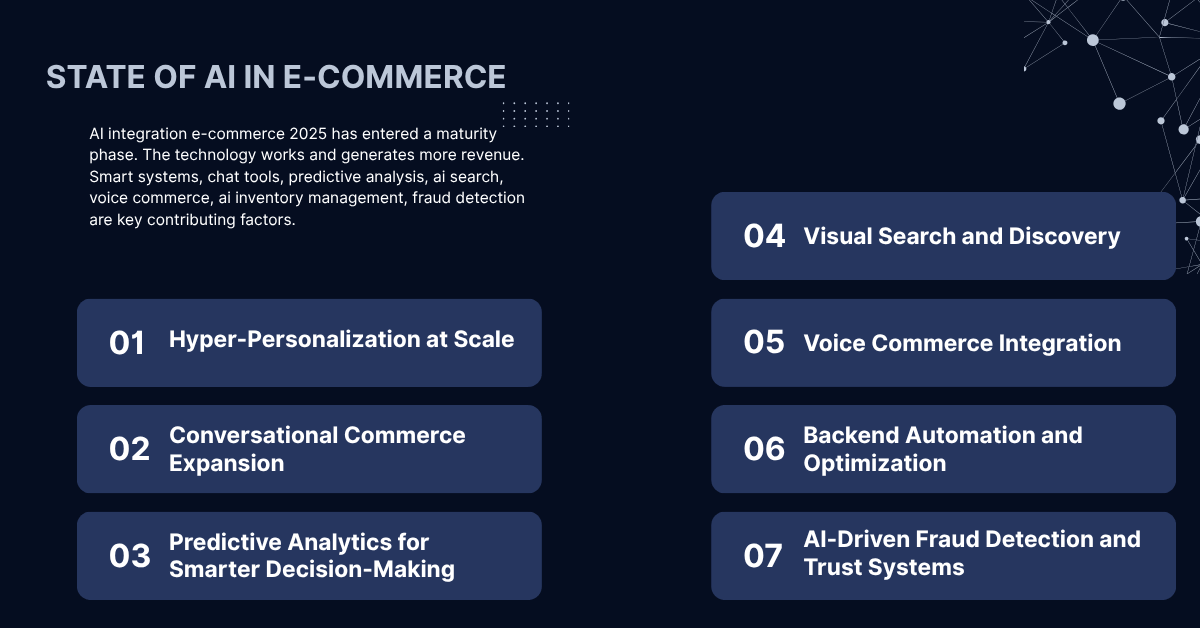
Personalization in 2025 will have turned from product suggestions to contextual intent prediction. With artificial intelligence, it has become possible to analyze user behavior in real time, considering subtle nuances such as browsing patterns, time of day, or even emotional tone.
By utilizing Python-based machine learning pipelines, e-commerce platforms can provide customers with customized experiences that adapt continuously as they change.
Chat programs have turned into virtual sales assistants that conversate with users via chat, voice, or video. Python tools like SpaCy and Transformers help these programs understand what people really mean when they ask questions. By deploying AI chatbots, e-commerce brands can provide customers with a more natural shopping experience, smoother checkout flows, and higher conversion rates.
Predictive models built using Python frameworks such as TensorFlow or scikit-learn are currently used to determine prices, forecast product demand, and determine trends before they occur. AI does not just react to problems. It helps plan ahead. Online store owners utilize Python-based predictive analytics to optimize margins, plan inventory, and make decisions in real-time.
With the evolution of AI, customers prefer to shop on platforms that allow them to search for products via images rather than manually typing. Python tools like OpenCV and Keras let customers upload photos and instantly find similar items. This has changed how people look for products online. Visual search e-commerce has become a key way to drive more sales for stores.
The next natural frontier for AI is voice commerce, which is becoming more commerce-aware with voice assistants such as Alexa, Siri, and Google Assistant. Through Python’s NLP libraries, customers can easily link their voice commands to shopping actions, such as “find black sneakers under $100”.
AI allows store owners to optimize the various behind-the-scenes elements that define the root of the store. This includes managing inventory optimization AI, managing warehouses, predicting shipping needs, and automatically routing orders. Using Python’s data-handling capabilities, these automated pipelines help operate more efficiently and reduce manual intervention.
Fake orders and stolen credit cards cost online stores billions every year. Python AI systems monitor every visitor who lands on the store to make a purchase and detect any suspicious activity that can lead to ecommerce fraud. Methods like unsupervised learning, clustering, and anomaly detection help companies stay safe without increasing the loading time.
Python has become the most preferred programming language for AI-powered e-commerce solutions. This leading partner for development maintains the right balance between accessibility, power, and ecosystem depth. Here are some of the leading reasons Python e-commerce AI continues to dominate this space.
Python is compatible with leading frameworks like TensorFlow, PyTorch, Keras, and scikit-learn. This provides developers with all the tools required to build AI models. They can build simple regression models to deep neural networks.
Libraries such as Pandas and NumPy make Python amazing for handling large e-commerce datasets. Millions of sales records can be cleaned up, changed, and studied through these programs. Stores can make smart decisions using enabling data-driven insights.
Python’s simplicity enables developers to move from ideas to prototypes quickly. It is imperative for startups and e-commerce founders to remain agile so they can experiment with models such as recommendation engines and dynamic pricing algorithms.
Some of the tools, such as SHAP and LIME, assist business teams in figuring out why the model made a particular prediction. Businesses can integrate machine learning into the existing platforms. It is compatible with Magento, WooCommerce, or Shopify without requiring a complete rebuild.
Python applications are easy to expand as you scale them to cloud environments such as AWS, Google Cloud, and Azure. Special tools like Ray and Dask distribute workloads. This ensures smooth operation at all times, even when many are shopping simultaneously.
Python’s global community is constantly updating libraries, frameworks, and best practices for AI projects, ensuring long-term sustainability and innovation.
Python integrates easily with big data platforms like Spark and Hadoop. This allows stores to build predictive analytics e-commerce Python systems capable of handling incredibly large amounts of information about customer behavior.
Once you have the fundamentals in place, the next thing is to determine how AI truly works within your online store.
All product suggestions for the inventory forecast are on the same course. You gather the data, train a model, make predictions using the model, and continue to improve. What changes in your goal? You may desire larger sales or higher profit margins, or longer-term customers.
The following are five key AI processes that any expanding online store should consider implementing in Python in 2025.
Personalized shopping is made possible by AI-driven systems that provide product recommendations. Python tools like Surprise, LightFM, or TensorFlow Recommenders help developers create models. These methods employ collaborative filtering, content-based filtering, and embedding-based vector searches.
Python is useful in creating models that forecast future sales, inventory requirements, and customer churn. With the help of techniques such as ARIMA, Prophet, or LSTM networks, stores can adjust prices automatically or predict what to order from their suppliers.
Programs such as SHAP and LIME are used to make business teams understand the motivation behind the model making a particular prediction.
Python chatbots such as Transformers, SpaCy, and NLTK can solve difficult and complex queries while maintaining contextual memory. Integrating AI chatbots into the e-commerce checkout process prevents people from abandoning their purchases and increases upselling opportunities.
These bots can also integrate voice recognition to support conversational commerce, making Python implementations that feel natural and personal.
Visual search relies on convolutional neural networks (CNNs) trained in Python to match photos uploaded by customers with items in the catalog. Voice search applies ASR (Automatic Speech Recognition) and NLP to interpret spoken queries. Collectively, they simplify and facilitate shopping. These are key distinctions that will count in the competitive online market of the year 2025.
AI workflows built in Python make everything run smoother, from inventory optimization AI to predicting supply chain needs. To prevent fraud, unsupervised models are used to detect anomalies in transaction patterns through reinforcement learning.
Example: a Python service analyzing sales data as it happens and automatically orders more of the items running low. It connects API calls to vendor systems.
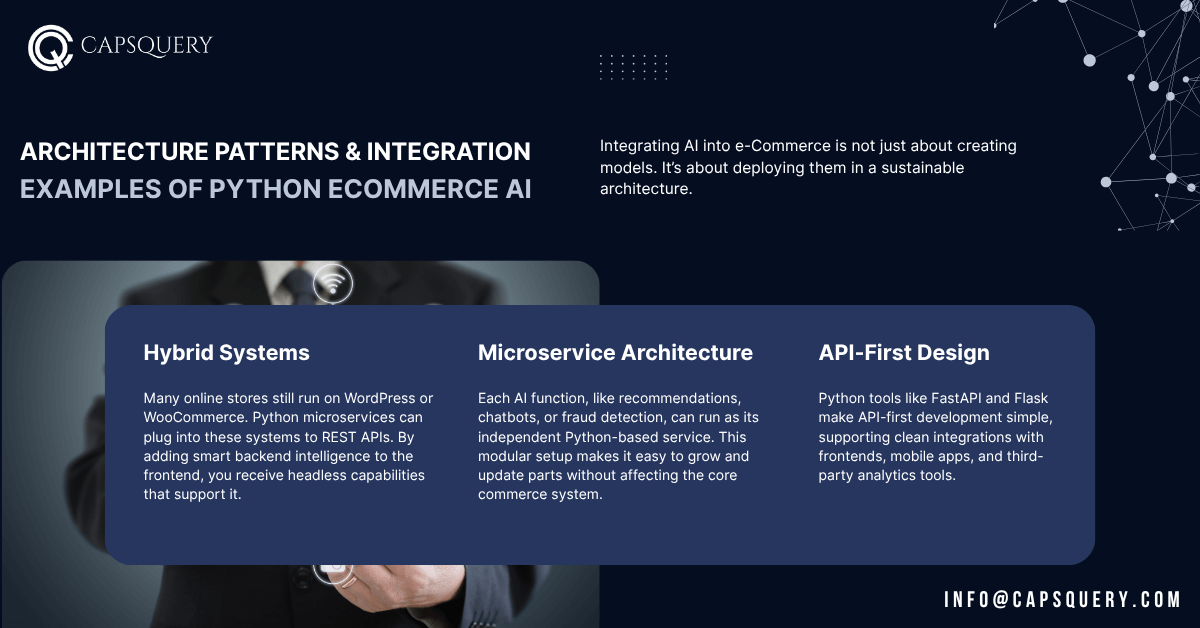
Integrating AI into e-commerce is not just about creating models. It’s about deploying them in a sustainable architecture.
Many online stores still run on WordPress or WooCommerce. Python microservices can plug into these systems to REST APIs. By adding smart backend intelligence to the frontend, you receive headless capabilities that support it.
Each AI function, like recommendations, chatbots, or fraud detection, can run as its independent Python-based service. This modular setup makes it easy to grow and update parts without affecting the core commerce system.
Python tools like FastAPI and Flask make API-first development simple, supporting clean integrations with frontends, mobile apps, and third-party analytics tools.
Capsquery helps worldwide clients transition from static e-commerce systems to AI-integrated Python architectures. Using custom-built microservices, our team of developers integrates features like real-time personalization and smart restocking without overhauling existing platforms.
With Python’s AI capabilities integrated into client APIs, Capsquery provides measurable ROI and solutions that can be tailored to meet customer needs.
Building AI systems for online stores with Python sounds easy on paper. You train a model, connect it, launch it, and watch money come in. Reality is full of problems you do not expect.

Data systems break down. Models stop working as well over time. Predictions get slow when lots of people use them. Rules about customer data change faster than anyone can keep up. Successful teams like Capsquery, a leading Texas AI e-commerce development company, treat these challenges not as roadblocks but as design constraints that shape robust systems.
Here are the biggest problems developers and technology leaders face when scaling Python AI workflows for online stores:
AI performance depends on data accuracy. It is imperative for businesses to prioritize clean, representative, and compliant data pipelines that comply with privacy laws such as GDPR and CCPA.
Consumer behavior evolves over time. Models that are not retrained get worse at their job. Setting up Python systems that retrain automatically using CI/CD tools keeps models working well.
E-commerce AI must give answers instantly. Using fast serving tools like TensorFlow Serving, ONNX Runtime, or FastAPI caching can minimize inference delays.
AI systems must protect customer data with encryption and check who can access information. They need role-based controls to keep personal details safe.
It is important for businesses to have explainable models. Using Python’s interpretability libraries (LIME, SHAP), decision-makers can trust predictions made with these libraries.

AI adoption in e-commerce is not about running after the trends. It’s about building a sustainable framework that drives measurable improvement in conversion, personalization, and operational efficiency. Most companies do not fail because their AI models are bad. They fail because they do not have a clear plan for integrating AI and scaling it over time.
Let’s look at a practical roadmap for companies ready to add and grow AI-powered systems using Python.
The biggest mistake companies make is starting with the algorithm, not the outcome. Before writing any Python code, decide what winning looks like for your business.
Do you want fewer people leaving items in their cart? Are there better ways for customers to find products? Automate supply chain forecasting?
When those goals are obvious, your AI initiatives have direction. At Capsquery, every project integrates quantifiable metrics. This includes conversion rates, average order size, and retaining customers. This way, AI performance gets measured like any other business KPI.
AI needs data that is clean, organized, and useful. Before training models, companies should check their data collection systems.
A Python-focused data setup using tools like Pandas, PySpark, and FastAPI enables teams to process large datasets effectively. The point is to move data smoothly from where it starts (your website, customer records, business software) through model training to actual use. Without this foundation, even the smartest AI plan falls apart because data is inconsistent.
One of the advantages of Python in 2025 is the speed at which you can develop, test, and debug. The most logical course of action is to begin with small and targeted tests that have a large impact.
For example, roll out an AI-enabled search suggestion system on your top 500 SKUs and then roll it out to the rest of your site. This lets you:
Once the prototype demonstrates ROI, scale horizontally. Extend it to related workflows like dynamic pricing or personalized email campaigns. Python tools like TensorFlow Extended (TFX) and MLflow simplify the jump from experimentation to production.
AI is not something you set up once and ignore forever. It’s a living system that changes with your business data. A model that works perfectly in Q1 might degrade by Q3 if the buyer’s behavior changes or data drifts.
That’s why continually tracking your models matters.
A system built to grow should include:
Python monitoring tools like EvidentlyAI and Weights & Biases help teams see and maintain these models efficiently. At Capsquery, governance rules go right into the deployment process. This ensures models stay fair, explainable, and follow changing privacy rules.
Once models work reliably, automation multiplies your growth.
MLOps practices using Python automation tools and cloud services let businesses automate repetitive steps. This includes retraining models, running batch predictions, and CI/CD deployments.
For example, an automated system might retrain demand prediction models every week using fresh sales data. It pushes updated settings to production and sends performance reports to analysts. All of this happens without anyone having to do it manually.
This not only makes things more reliable but also lets data teams focus on strategy instead of maintenance.
Scaling AI is not just a technology problem. It’s an organizational one. The best Python AI systems involve cross-functional teams. This brings data engineers, developers, and business strategists to the same table.
This teamwork is where real value shows up. When everyone understands what the model predicts and the reasons behind it, decisions happen faster and with more confidence.
In 2025, AI workloads will do best in cloud environments. Platforms like AWS SageMaker, Google Vertex AI, and Azure ML work smoothly with Python tools. They offer flexible computing power, managed deployments, and the ability to scale up when needed.
For online stores handling thousands of simultaneous requests every second, this flexibility ensures that AI features like personalized search or fraud detection work quickly, even during busy shopping hours.
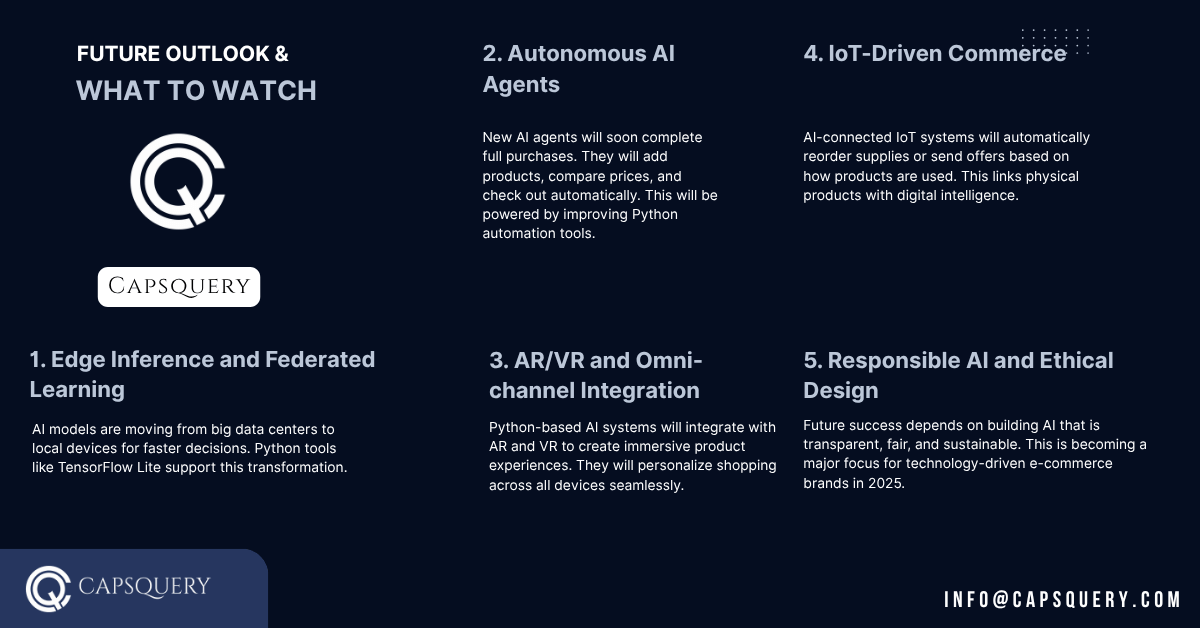
AI models are moving from big data centers to local devices for faster decisions. Python tools like TensorFlow Lite support this transformation.
New AI agents will soon complete full purchases. They will add products, compare prices, and check out automatically. This will be powered by improving Python automation tools.
Python-based AI systems will integrate with AR and VR to create immersive product experiences. They will personalize shopping across all devices seamlessly.
AI-connected IoT systems will automatically reorder supplies or send offers based on how products are used. This links physical products with digital intelligence.
Future success depends on building AI that is transparent, fair, and sustainable. This is becoming a major focus for technology-driven e-commerce brands in 2025.
Python keeps redefining what’s possible in AI-powered e-commerce. It automates workflows, improves personalization, and adds operational intelligence. Python has grown from just a programming language into a strategic tool for business growth.
If your business wants to transform customer experience, make backend processes smoother, or deploy intelligent recommendation systems, Capsquery can help.
As a global custom website development company, Capsquery builds complete Python AI e-commerce solutions from start to finish. We combine innovation with the ability to grow. This helps brands in Cupertino, Houston, Dallas, and more evolve into intelligent, future-ready commerce systems.
Website Development | Mobile App Development | Application Development
We will definitely get back in touch with you over mail within 12 Hours.
In-case you have not heard from us within 12 hours, kindly check your spam once.
I'm a software consultant. I've 7+ years of industry experience. I'd love to connect with you and brainstorm your custom software needs. It's my responsibility to find you the best solution.
ANAND GUPTA
Drop your details and we'll get in touch with you within 12 hours.
Reach us for

Talk to us