

Jul
14
It’s a hectic Monday morning, and you’re settling in with your coffee, prepared to handle the day’s requests. You check your inbox, and it is flooded with alerts, recent purchases, client questions, and a persistent reminder: “Remember to ship these today!” If you’ve ever run an eCommerce website, you know the above struggle is real. Shipping isn’t just about putting labels on boxes; it’s the lifeline that connects your products to your customers’ doorsteps. Efficient shipping isn’t a luxury; it’s a necessity.
It’s where shipping APIs come into play. By integrating these powerful tools into your web development process, you can transform shipping from a chaotic scramble into a well-choreographed performance.
So, what are shipping APIs, and why should you care? Simply put, Shipping APIs (Application Programming Interfaces) are the digital bridges that connect your eCommerce website to multiple shipping carriers. These include but are not limited to FedEx, UPS, and DHL.
With a shipping API, you don’t need to manually log into each carrier’s portal, copy and paste addresses, calculate rates, and generate labels by hand. It will handle everything for you. It’s like having a dedicated shipping assistant who never sleeps.
Here’s what shipping APIs typically offer:

Imagine you’re checking out on Amazon and get to choose between standard, two-day, or overnight shipping, with accurate costs displayed instantly. That’s the magic of real-time rate calculations. Rather than guessing shipping fees, customers see exact costs from multiple carriers. Thus helping them make informed decisions.
No more wrestling with PDF label templates or risking typos on shipping labels. APIs autofill shipping details (address, weight, dimensions, service type) and generate printable labels instantly. You click a button, and boom, the label is ready.
Shipping APIs can push real-time tracking updates directly to your site or via email/SMS. As a result, customers know exactly where their order is, from the warehouse to the front door.
Returns are inevitable, but they don’t have to be painful. With a robust API, you can provide pre-paid return labels and streamlined instructions. Thus making the process painless for customers and reducing your support tickets.
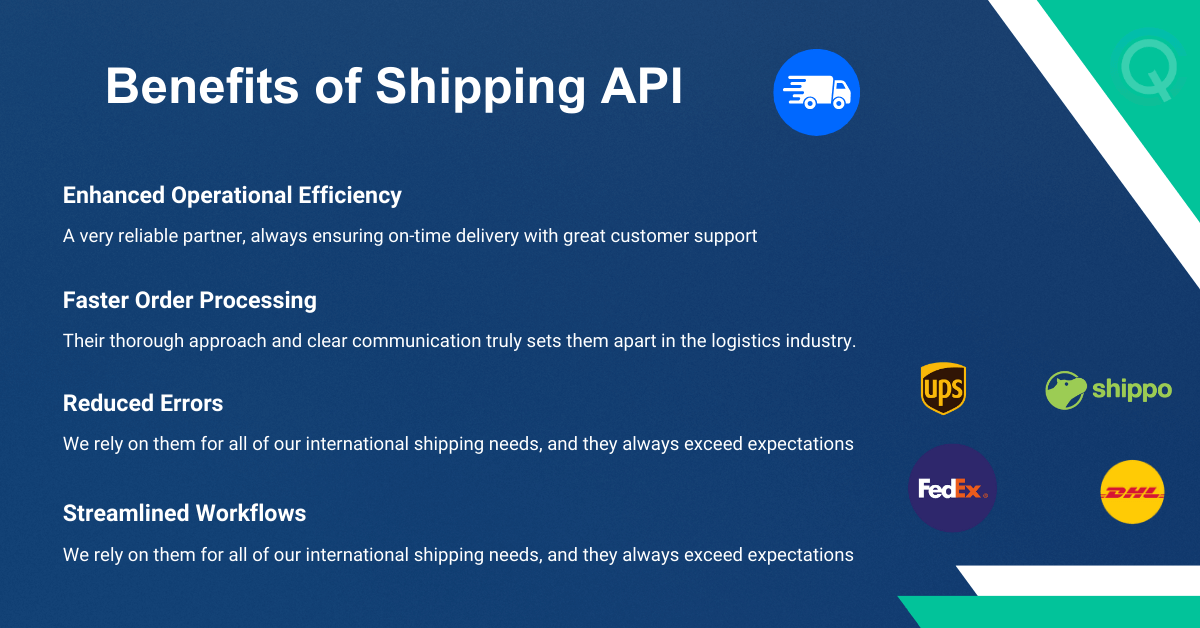
Manual shipping processes are a massive time sink. Picture your team juggling spreadsheets, printing labels one by one, and manually entering tracking numbers into your order management system. It’s exhausting. When you integrate a shipping API, you automate these repetitive tasks. Suddenly, generating a label becomes a one-click affair, and tracking numbers auto-populate in customer profiles. This frees you and your team to focus on higher-value tasks like marketing campaigns, product development, or customer outreach.
With a few lines of code, your system can pull shipping rates, generate labels, and send tracking details to customers in seconds. No more waiting around for a shipping clerk to come online.
Even the smallest typo in a shipping address can lead to returned packages and upset customers. APIs validate addresses against carrier databases in real-time. Thus ensuring accuracy before labels are printed.
Most shipping APIs play nicely with your existing Order Management System (OMS), Warehouse Management System (WMS), and Customer Relationship Management (CRM) tools. This seamless integration means data flows smoothly from one system to another, eliminating duplicate work and data silos.
Shipping APIs enable you to offer exceptional customer experience, thanks to:
Instead of sending one generic “Your order has shipped” email, you can provide a dynamic tracking link that shows exactly where a package is, down to the city and time of the scan. It builds trust and reduces support inquiries (“Where’s my order?”).
Some customers wanted their boxes yesterday; others are perfectly happy waiting a few extra days for free shipping. With an API, you can display a range of options ( standard, expedited, overnight) and let customers choose the one that fits their budget and timeline.
A clear, easy return process is a deal-breaker for online shoppers. By integrating returns management into your API, you can auto-generate pre-paid return labels when needed and provide step-by-step instructions. Happy returns management can turn a potentially negative experience into another opportunity to impress.
Say your midnight flash sale goes viral, and you suddenly have a flood of orders. Can your current shipping process handle it? If you’re still manually processing each shipment, the answer is likely “no.” Shipping APIs offer the scalability to take on surges without breaking a sweat. Because the heavy lifting (rate calculations, label printing, tracking updates) is handled automatically, your system can process hundreds (or even thousands) of orders per hour without you having to hire an army of temporary staff.
Finding the perfect shipping solution can feel like standing at a crossroads. Do you go with a single carrier’s API? Partner with a local last-mile specialist? Or opt for an all-in-one platform that aggregates everyone? Let’s walk through three common paths so you can picture what fits best for your business.
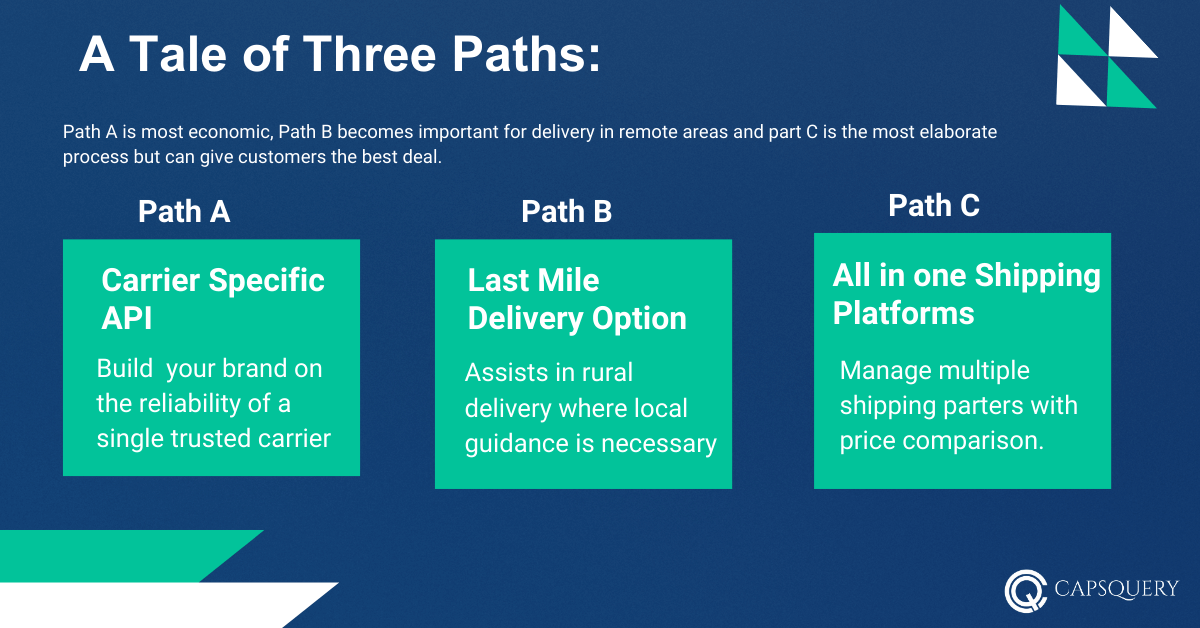
Imagine you’ve built your brand on the reliability of a single carrier, say, FedEx, FedEx, UPS, or DHL. For instance, using the FedEx API gives you direct access to:
Print FedEx labels on demand, complete with barcodes and tracking numbers.
Get updates from FedEx’s network so you can relay them directly to customers.
If you sell globally, FedEx handles customs forms and duties calculations behind the scenes.
But there’s a tradeoff: if FedEx raises rates or has service disruptions, you’re at the mercy of one carrier. That being said, if you do high-volume business with FedEx and have negotiated favourable rates. Thus, sticking with a single-carrier API can be cost-effective and straightforward.
In some regions, last-mile delivery companies can be the trickiest leg of the journey, especially if you serve remote or rural areas. That’s when partnering with companies like Blue Dart or Delhivery can be a game-changer. They offer:
Reaching pin codes and neighbourhoods that larger international carriers sometimes miss.
Same-day, next-day, or scheduled deliveries that cater to local preferences.
More granular updates once a package enters the local distribution hubs.
The catch? These carriers may not offer global reach. If your primary audience is within India, however, last-mile specialists can be your secret sauce for lightning-fast domestic deliveries.
If you dream of one-stop shipping platforms (where you can manage FedEx, Blue Dart, Delhivery, and even cost-effective local couriers all from one place), an all-in-one platform might be your best bet. These solutions offer:
Imagine seeing all your shipments, regardless of carrier, in a single interface. You can track statuses, manage returns, and generate reports without constantly switching platforms.
Some platforms analyse shipping data to recommend the most cost-effective carriers, optimal packaging sizes, and the best times to ship to minimise delays.
Whether you need to send SMS updates in a specific language or print packing slips that match your brand colours, these platforms allow deep customisation.
The downside? There’s usually a monthly fee on top of your carrier costs and sometimes a per-label fee. But if you juggle multiple carriers and want centralised control, the time and administrative savings are worth considering.
Alright, so you’re sold on the idea of shipping APIs. What’s next? How do you actually bring this magic to life with web development?
Let’s break it down into clear, digestible steps.
Before you begin, ask yourself:
If you’re shipping a handful of packages each week, a simple carrier-specific API might suffice. If you’re processing hundreds or thousands of orders daily, you might need that all-in-one solution.
Domestic only? International? Remote rural areas? Your shipping destinations matter.
Do you use Shopify, WooCommerce, Magento, or a custom-built platform? Some shipping APIs offer pre-built plugins or extensions for popular platforms. Thus making integration easier.
With these insights, research and shortlist 2–3 APIs. Reach out to their developer support teams, read documentation, and check if they offer sandbox environments for testing. Here’s a quick checklist:
Choosing an API is like choosing a business partner; do your homework before signing on.
Once you’ve decided, the real fun begins. Work with a web development expert ( to connect your eCommerce website to the API. Most integrations involve:
After the initial integration, don’t just hit “go” and cross your fingers. Run comprehensive tests:
Use this testing phase to collect feedback from a small group, perhaps trusted friends or a beta group of customers, before rolling out site-wide.
Congratulations, you’re live! But your work doesn’t end here. Integrations need regular check-ups:
You might be thinking, “This all sounds great, but what about the real-world roadblocks ?” Fair question. Let’s tackle some common worries head-on.
Short answer: Not if you plan and test properly. Modern shipping APIs are designed for smooth integration. During your initial setup, you can run the API in parallel with your existing shipping process. Once you confirm everything works flawlessly, you can switch over entirely. This “parallel run” approach minimises downtime and lets you catch potential hiccups early.
Absolutely. While there might be an upfront fee for premium API features or a monthly subscription, the long-term savings are substantial:
Remember, in the world of eCommerce, every cent counts. Even a 5–10% reduction in shipping costs can significantly impact your profit margins.
One of the biggest misconceptions is that automation equals “impersonal.” In reality, shipping APIs can power highly personalised experiences:
By now, you’ve seen how shipping APIs can turn that chaos into a seamless, almost effortless routine. It automatically fetches rates, generates labels, sends real‑time tracking updates, and even handles returns without breaking a sweat. Whether you choose a single‑carrier solution for its simplicity, partner with a last‑mile specialist to conquer those hard‑to‑reach addresses or adopt an all‑in‑one platform for total control, the path forward is clear:
In doing so, you’ll not only cut down on manual errors and labour costs but also offer your customers the transparency and reliability they crave. Thus transforming shipping from a dreaded chore into a powerful extension of your brand promise. As order volumes surge, you’ll rest easy knowing your eCommerce fulfillment process scales effortlessly, keeping customers delighted and coming back for more.
Are you ready to replace eCommerce shipping stress with smooth, smart solutions? Let’s make it happen together. At Capsquery, we specialise in tailoring, integrating, and optimising shipping APIs and web development services to fit your unique needs.
Contact us today for a consultation, and let’s write the next chapter of your eCommerce website success story.

Website Development | Mobile App Development | Application Development
We will definitely get back in touch with you over mail within 12 Hours.
In-case you have not heard from us within 12 hours, kindly check your spam once.
I'm a software consultant. I've 7+ years of industry experience. I'd love to connect with you and brainstorm your custom software needs. It's my responsibility to find you the best solution.
ANAND GUPTA
Drop your details and we'll get in touch with you within 12 hours.
Reach us for

Talk to us